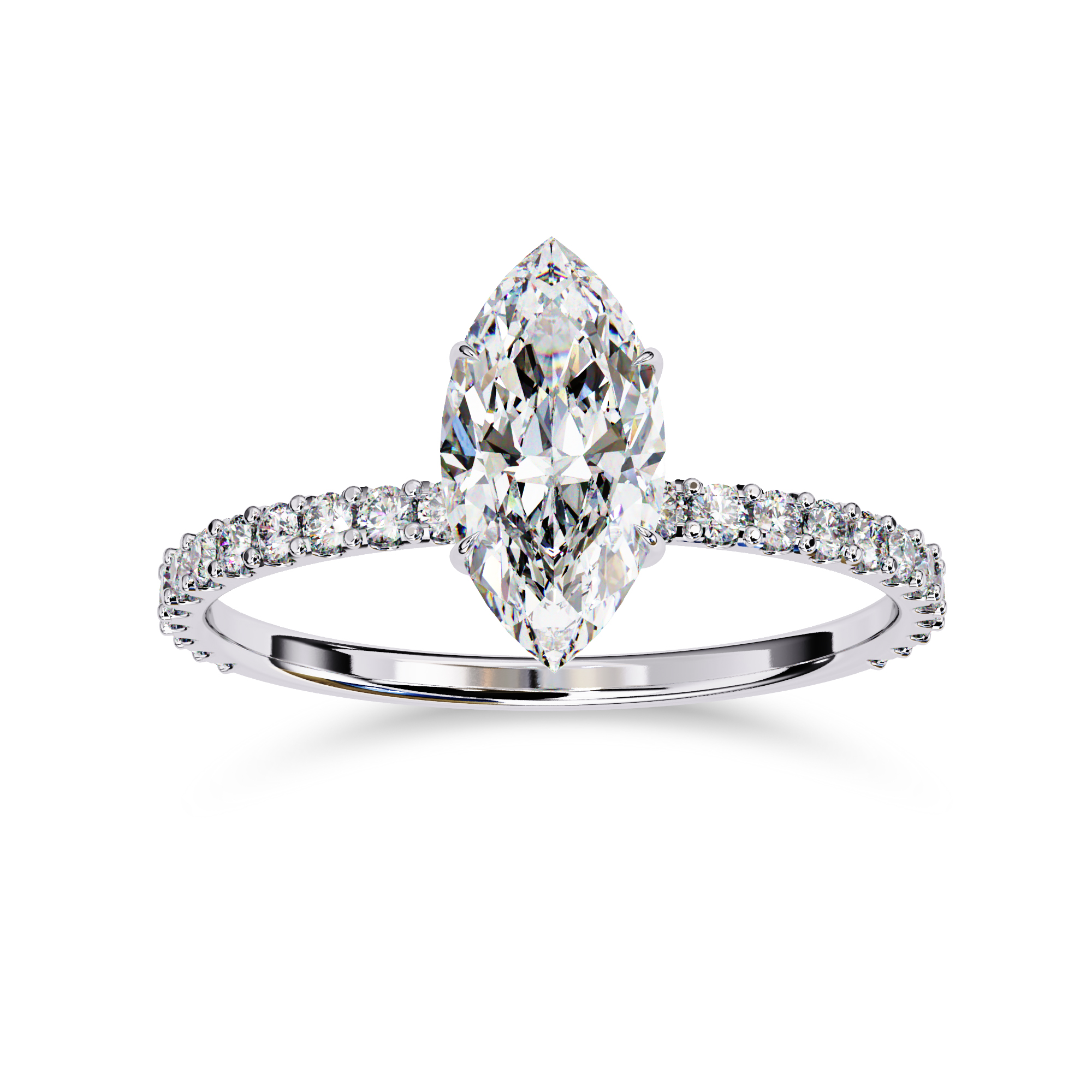
- Is a lab-grown diamond a real diamond?
- Yes. It has the same carbon crystal structure, hardness and optical properties as a mined diamond. The difference is origin: it is grown in a lab rather than formed underground.
- How does a radiant cut differ from an emerald cut?
- Both are rectangular with trimmed corners. The emerald cut has long, step-like facets and a quieter, glassy look; the radiant cut has brilliant-style facets and more sparkle, and it hides inclusions better.
- What is a hidden halo?
- It is a ring of small diamonds set around the base of the center stone, below the girdle. You see it from the side, not from directly above, so the top view stays close to a solitaire.
- Will the pave band lose stones?
- Pave settings hold small stones with tiny metal beads, and they can loosen with daily wear. Have the ring checked by a jeweler once or twice a year and avoid knocking it against hard surfaces.
- Can this ring be resized?
- A pave band limits resizing because the stones run along the shank. Small adjustments are usually possible, but a large change may need the band rebuilt; ask the jeweler before buying.
- What should I check on the center stone?
- Ask for the lab-grown diamond's grading report and look at cut grade, color and clarity. In a radiant cut, a poorly cut stone can show dark areas or a visible bow-tie effect.
- Where is the Radiant Cut Lab Grown Diamond Pave Engagement Ring cheapest?
- At Amazon, for CA$1,199.99, 65% under what the other stores charge, as of our latest check.
- What do buyers say about the Radiant Cut Lab Grown Diamond Pave Engagement Ring?
- Rated 5 out of 5 from 4 ratings.
- Where can I buy the Radiant Cut Lab Grown Diamond Pave Engagement Ring?
- 3 stores we checked sell it, including Diamondrensu, Diamondrensu Canada, Amazon.