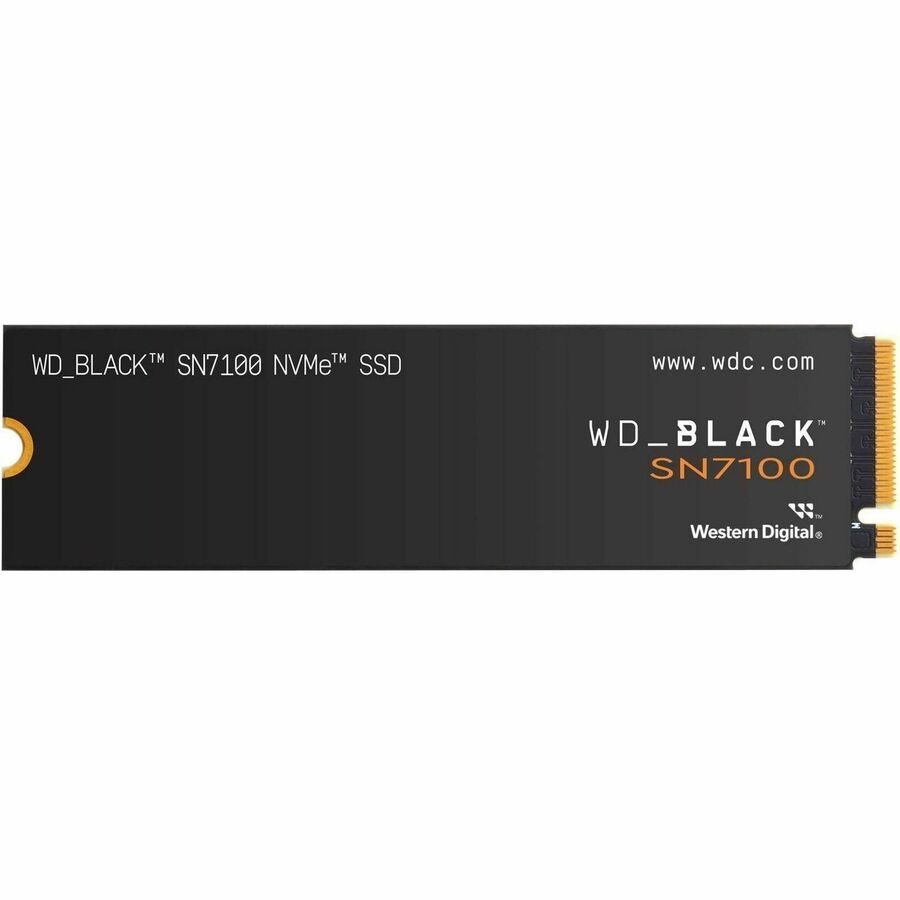
- Which is better for a PS5?
- The Lexar NM790. Lexar lists PlayStation 5 compatibility, and the drive reaches 7,400 MB/s read. The SN7100 listing names PC only.
- Which one is faster?
- The NM790 reads faster at up to 7,400 MB/s versus 7,250 MB/s. The SN7100 writes faster at up to 6,900 MB/s versus 6,500 MB/s. Real-world game loads will feel close.
- Which fits a thin laptop?
- The SN7100 is listed as single-sided, which suits tight M.2 slots. The NM790 is not described as single-sided, so check clearance before buying for a slim laptop.
- Do either have a DRAM cache?
- No. Both are DRAM-less. The NM790 uses HMB 3.0 and Dynamic SLC Cache to offset that, and the SN7100 relies on the same host memory approach.
- Which has more capacity options?
- The NM790, which comes in 512 GB, 1 TB, 2 TB, 4 TB and 8 TB. The SN7100 goes up to 4 TB.
- Is the WD Black SN7100 worth stepping up to?
- Only for its single-sided build and higher stated write speed. The NM790 reads faster on paper and comes in much larger capacities. For most PC and PS5 builds the NM790 covers more.
- Does the SN7100 support encryption?
- It is listed as non-SED, so no self-encrypting drive support. It does list TRIM, ECC and SMART. The NM790 listing states no encryption details either way.
- Which uses less power?
- Lexar claims the NM790 uses up to 40% less power than DRAM cache-enabled PCIe Gen 4 SSDs. The SN7100 is listed with low power consumption but no figure. For a battery-limited handheld or laptop, both are worth checking against the device's slot.
- Is the SN7100 built for gaming handhelds?
- Yes. WD says it was engineered with laptops and gaming handhelds in mind, and it uses next-generation TLC 3D NAND for power efficiency at speed. The NM790 is aimed at gamers, professionals and creators, with PS5 listed.
- Does the NM790 work in a desktop PC?
- Yes. Lexar lists desktop computers and laptops alongside the PlayStation 5, and the drive is a standard M.2 2280 PCIe Gen4 x4 part.