StoreDeal.ai store
Shop
  • Deals
  • Deal checker
  • Black Friday
  • Buying guides
  • Brands
  • Stores
Travel
  • Flight deals
  • Hotel deals
Company
  • Research
  • Press
  • Use in AI assistants
  • Contact
  • deal.ai apps
Black Friday 2026
  • Walmart
  • Best Buy
  • Target
  • TVs
  • Laptops
  • Headphones
  • Apple
  • Gaming
  • Vacuums
  • Kitchen
  • Toys
  • Smartwatches
  • Tablets
  • Furniture
  • Mattresses
© Deal.ai Inc.·2222 Ponce de Leon Blvd, Miami, FL 33134·support@deal.ai
TermsPrivacy
Deal.ai › Compare

Sky-Watcher Classic 150P Dobsonian vs Celestron StarSense Explorer DX 130AZ

For most first-time buyers, the Celestron StarSense Explorer DX 130AZ is the easier telescope to live with: the phone dock finds objects for you, and the whole kit weighs 18 lb. The Sky-Watcher Classic 150P wins on raw optics, with a 254 mm mirror that pulls in far more light and shows finer detail on planets and faint clusters. The Celestron's 130 mm parabolic mirror still gathers about 60% more light than a 4-inch refractor, and owners rate it 4.8 out of 5.

  • Choose the Sky-Watcher Classic 150P if you want the most aperture for the money and are willing to learn star-hopping and collimation.
  • Choose the Celestron StarSense Explorer DX 130AZ if you want a lighter, phone-guided scope that finds targets for you on the first night.

Prices

  • Sky-Watcher Classic 150P Dobsonian: $315.00 at Amazon (last seen Nov 19)
  • Celestron StarSense Explorer DX 130AZ: $128.99 at telescopes.us.com (last seen Nov 19)
  • Difference: the Celestron StarSense Explorer DX 130AZ is $186.01 cheaper than the Sky-Watcher Classic 150P Dobsonian at the latest prices (Nov 19)
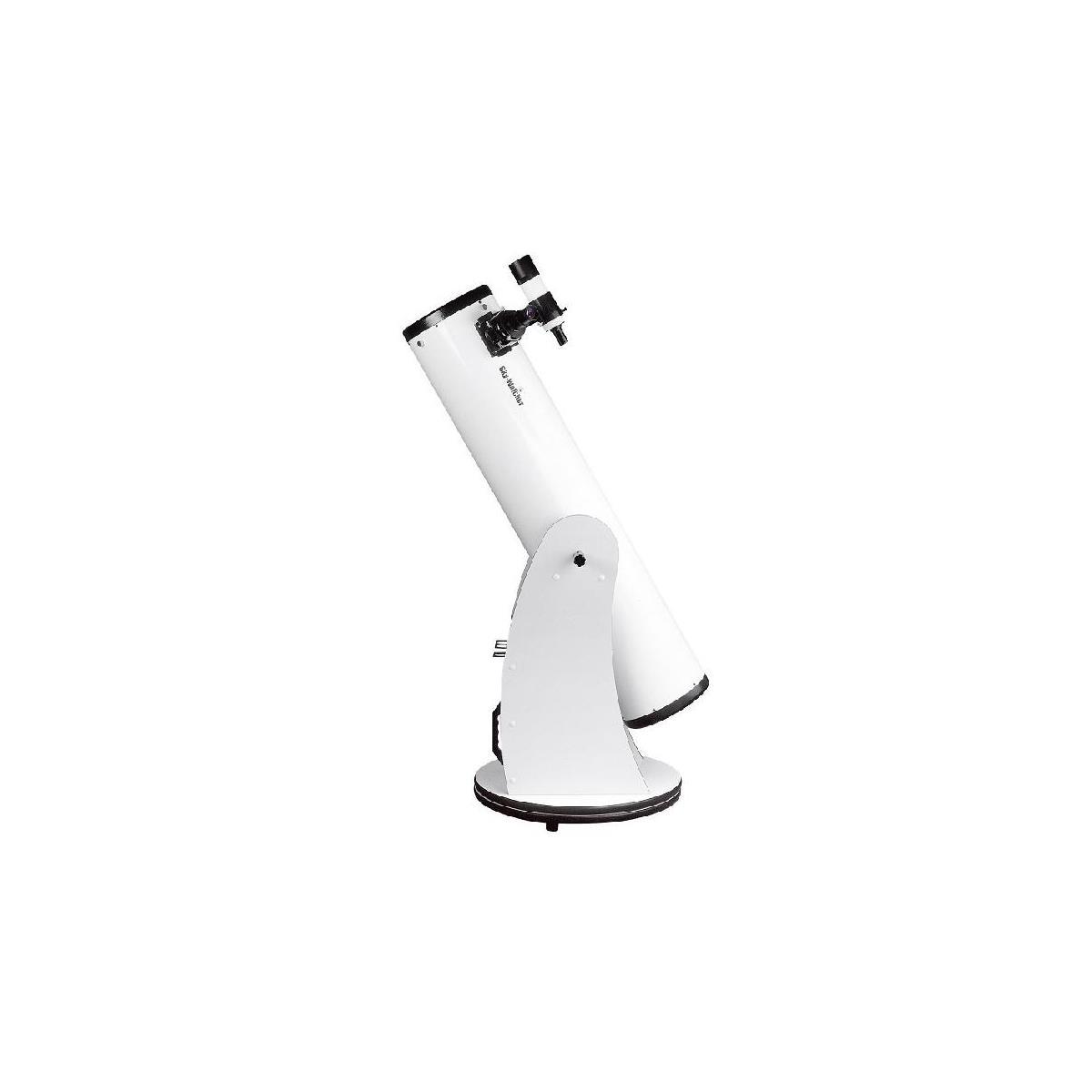
Sky-Watcher
Sky-Watcher Classic 150P Dobsonian Telescope

Sky-Watcher Classic 150P Dobsonian

Sky-Watcher Classic 150P Dobsonian Telescope

5(1 rating)
$315.00at AmazonChecked Nov 19
See all prices and details
Visit Amazon

Store links may earn us a commission. As an Amazon Associate, Deal.ai earns from qualifying purchases.

Pros
  • 254 mm aperture shows planets, globular clusters and galaxies with real detail
  • 1200 mm focal length gives high power on the Moon and planets
  • Parabolic mirror controls spherical aberration
  • Tension control handle keeps the tube steady while you push
  • Solid Dobsonian base is stable and simple, with no electronics to fail
Cons
  • Heavy particleboard base and long tube are awkward to move
  • No Go-To or tracking, so you must learn to star-hop
  • f/4.7 ratio demands more careful collimation
  • No fine focus knob, so high-power focusing is touchy
  • No eyepieces listed in the specs
Celestron
Celestron StarSense Explorer DX 130AZ Reflector Telescope

Celestron StarSense Explorer DX 130AZ

Celestron StarSense Explorer DX 130AZ Reflector Telescope

4.8(12 ratings)
$128.99at telescopes.us.comChecked Nov 19
See all prices and details
Visit telescopes.us.com
Pros
  • StarSense app uses your phone to point you to targets
  • Light 18 lb kit splits into tube and tripod
  • Wide f/5 field frames the Pleiades and Andromeda well
  • Two eyepieces included, 26x and 65x
  • Eyepiece sits high on the tube for comfortable viewing
Cons
  • 130 mm aperture limits faint deep-sky objects
  • Manual alt-az mount, no tracking or Go-To motors
  • Needs occasional collimation like any Newtonian
  • Tripod can vibrate at high power in wind
  • Runs on your phone's camera and app, with no motors or batteries of its own

What separates them

Sky-Watcher Classic 150P DobsonianCelestron StarSense Explorer DX 130AZ
Aperture254 mm primary mirror130 mm primary mirror
Light gatheringAbout 3.8x the light of a 130 mm scopeAbout 60% more than a 4-inch refractor
Focal length and ratio1200 mm at f/4.7650 mm at f/5
Finding targetsOptical finderscope, manual star-hoppingStarSense phone dock with app arrows
MountParticleboard Dobsonian rocker boxAluminum alt-azimuth tripod, 49 in max height
Weight and portabilityBulky solid-tube Dobsonian, two-piece carry18 lb total kit, breaks into tube and tripod
Eyepieces includedNot stated in the listing25 mm (26x) and 10 mm (65x)
Tracking and Go-ToNone, manual pushNone, manual push with app guidance
Useful magnification range36x to 300x19x to 307x
Owner ratingsNo rating given4.8 out of 5 from 12 ratings

Price history

$479.95$128.99
Nov 3Nov 20
  • Sky-Watcher Classic 150P Dobsonian: lowest $315.00 on Nov 20 at Amazon.
  • Celestron StarSense Explorer DX 130AZ: lowest $128.99 on Nov 3 at telescopes.us.com; $128.99 on Nov 20.

Prices at every store

Sky-Watcher Classic 150P Dobsonian

  • AdoramaNew

    In stock

    $449.00Free shippingChecked Nov 19
    Visit Adorama
  • WalmartNew

    In stockSold by AdoramaReturns: Sold by a Walmart Marketplace seller; returns go to the seller under the seller's returns policy.

    $669.00Free shippingChecked Nov 19
    Visit Walmart
  • AmazonNew

    Availability unknown

    As an Amazon Associate, Deal.ai earns from qualifying purchases.

    $315.00Free shippingChecked Nov 19
    Visit Amazon
  • Sunny SportsNew

    Availability unknown

    $449.00Free shippingChecked Nov 19
    Visit Sunny Sports

Store links may earn us a commission. Some prices via Klarna.

All 4 stores and price history →

Celestron StarSense Explorer DX 130AZ

  • telescopes.us.comNew

    In stock

    $128.99Checked Nov 19
    Visit telescopes.us.com
  • AmazonNew

    Availability unknown

    As an Amazon Associate, Deal.ai earns from qualifying purchases.

    $424.96Free shippingChecked Nov 19
    Visit Amazon
  • High Point ScientificNew

    Availability unknown

    $449.95Checked Nov 19
    Visit High Point Scientific
  • carnegiemuseums.orgNew

    Availability unknown

    $479.95Checked Nov 9
    Visit carnegiemuseums.org

Also available at

  • Celestron.comCheck price at Celestron.com
  • AstronomicsCheck price at Astronomics
  • Nankin HobbyCheck price at Nankin Hobby

Store links may earn us a commission.

All 26 stores and price history →

Specs compared

SpecSky-Watcher Classic 150P DobsonianCelestron StarSense Explorer DX 130AZ
Focal Length1200 mm650mm (25.59")
Focal Ratiof/4.7f/5
Aperture254 mm130mm (5.11")
Mount TypeDobsonianManual Alt-Azimuth
Product TypeTelescope—
Magnification300x (with 4mm Astromania Planetary eyepiece)—
Maximum Magnification300x (most that typical atmospheric conditions …—
Minimum Magnification36—
ZoomYes, 10.6 (ratio)—
Performance Resolution0.55 (rayleigh limit)—
Performance Brightness57% (light gathering compared to next size down)—
Objective Diameter254 mm—
Show all 35 specsShow fewer specs
SpecSky-Watcher Classic 150P DobsonianCelestron StarSense Explorer DX 130AZ
Optical TypeNewtonian Reflector—
Optical Diameter64 mm (secondary)—
DigitalNo—
Field Of View70-Degree Wide Angle—
Barlow LensCompatible—
FinderscopeYes—
Camera AdaptableYes—
Computerized FunctionalityNo—
Motorized MountNo—
Go-To Mount

What reviewers say

Sky-Watcher Classic 150P Dobsonian

Owners of the 150P generally rate it as a strong first serious telescope, praising the light grasp and simple mount. Complaints center on the bulky base and the need to collimate and add eyepieces.

What people mention
  • OpticsPraisedOwners say the parabolic mirror gives crisp views for the price.
  • MountMixedThe Dobsonian base is stable but heavy and bulky to move.
  • SetupMixedAssembly is quick, but collimation takes practice.
  • FocuserCriticisedThe single-speed focuser feels coarse at high magnification.

Celestron StarSense Explorer DX 130AZ

  • 4.8 / 512 ratings

Rated 4.8 out of 5 from 12 ratings. Owners praise how quickly the StarSense app gets them onto targets and the bright views from the 130mm mirror. The usual complaints are collimation and the manual mount's lack of tracking.

What people mention
  • StarSense appPraisedOwners say the phone-guided pointing gets them to targets quickly instead of hunting by star-hopping.
  • Optical brightnessPraisedThe 130mm aperture gives bright views of clusters, nebulae and galaxies.
  • CollimationCriticisedReviewers note the Newtonian mirrors need occasional collimation to stay sharp.

Questions and answers

Which is better for seeing planets?
The Sky-Watcher 150P, on paper. Its 254 mm mirror and 1200 mm focal length give more resolution and light, so Jupiter's belts and Saturn's rings hold up better at high power. The Celestron still shows the planets well at 65x with the included 10 mm eyepiece.
Which is easier for a beginner?
The Celestron. The StarSense app points your phone at the sky and shows arrows to each object, so you spend the night looking instead of searching. The Sky-Watcher needs you to learn star-hopping with a finderscope.
Which one is more portable?
The Celestron. The whole kit is 18 lb and splits into an 8.8 lb tube and a 9.2 lb tripod. The Sky-Watcher's particleboard Dobsonian base and long tube are bulkier and heavier to carry.
Do either of them track objects automatically?
No. Both are manual mounts with no motors or Go-To. The Celestron's app guides you to a target, but you still push the scope to follow it as the Earth turns.
Which shows more deep-sky objects?
The Sky-Watcher, because aperture wins. Its 254 mm mirror gathers roughly 3.8 times the light of the Celestron's 130 mm, so faint galaxies and nebulae are brighter and more detailed.
Is the Celestron worth stepping up to?
It depends on what you want from the night. You pay for the phone dock and the lighter mount, and in return you get guided finding and a kit you can carry in one trip. If raw light grasp matters more to you, the Sky-Watcher's larger mirror does more.
Does the Celestron need batteries?
No. The StarSense dock uses your phone's camera and the free app, with no motors or batteries. You do need a charged phone to use the guidance.

Ask our shopping agent

It checks today's price at every store, compares the alternatives and answers in about a minute.

Enter to send, Shift+Enter for a new line

More comparisons

  • NexStar 130 SLT Computerized Telescope vs Celestron StarSense Explorer DX 130AZ Reflector Telescope
  • Sky-Watcher Classic 150P Dobsonian Telescope vs Celestron AstroMaster 130EQ Newtonian Reflector Telescope
  • Celestron StarSense Explorer DX 130AZ Reflector Telescope vs Celestron StarSense Explorer DX 5" SCT
  • Celestron StarSense Explorer DX 130AZ Reflector Telescope vs Celestron PowerSeeker 127EQ Newtonian
  • Celestron AstroMaster 130EQ Newtonian Reflector Telescope vs Celestron StarSense Explorer DX 130AZ Reflector Telescope
  • Gskyer 90 Explore vs Celestron StarSense Explorer DX 130AZ Reflector Telescope
No
—
Mount MaterialParticleboard—
Fine FocusNo (dual-speed fine focus knob)—
colorBlack—
Built-In CameraNo—
BatteryNo—
Optical design—Newtonian Reflector | Parabolic Primary Mirror
Highest useful magnification—307x
Lowest useful magnification—19x
Limiting stellar magnitude—13.1
Optical tube weight—8.8 lbs (3.99 kg)
Tripod weight—9.2 lbs (4.17 kg)
Total kit weight—18 lbs (8.16 kg)
Max height—Aluminum, 1244.6mm (49") max height
  • Mount trackingMixedThe manual alt-azimuth mount is simple but does not track, so objects drift out of view.