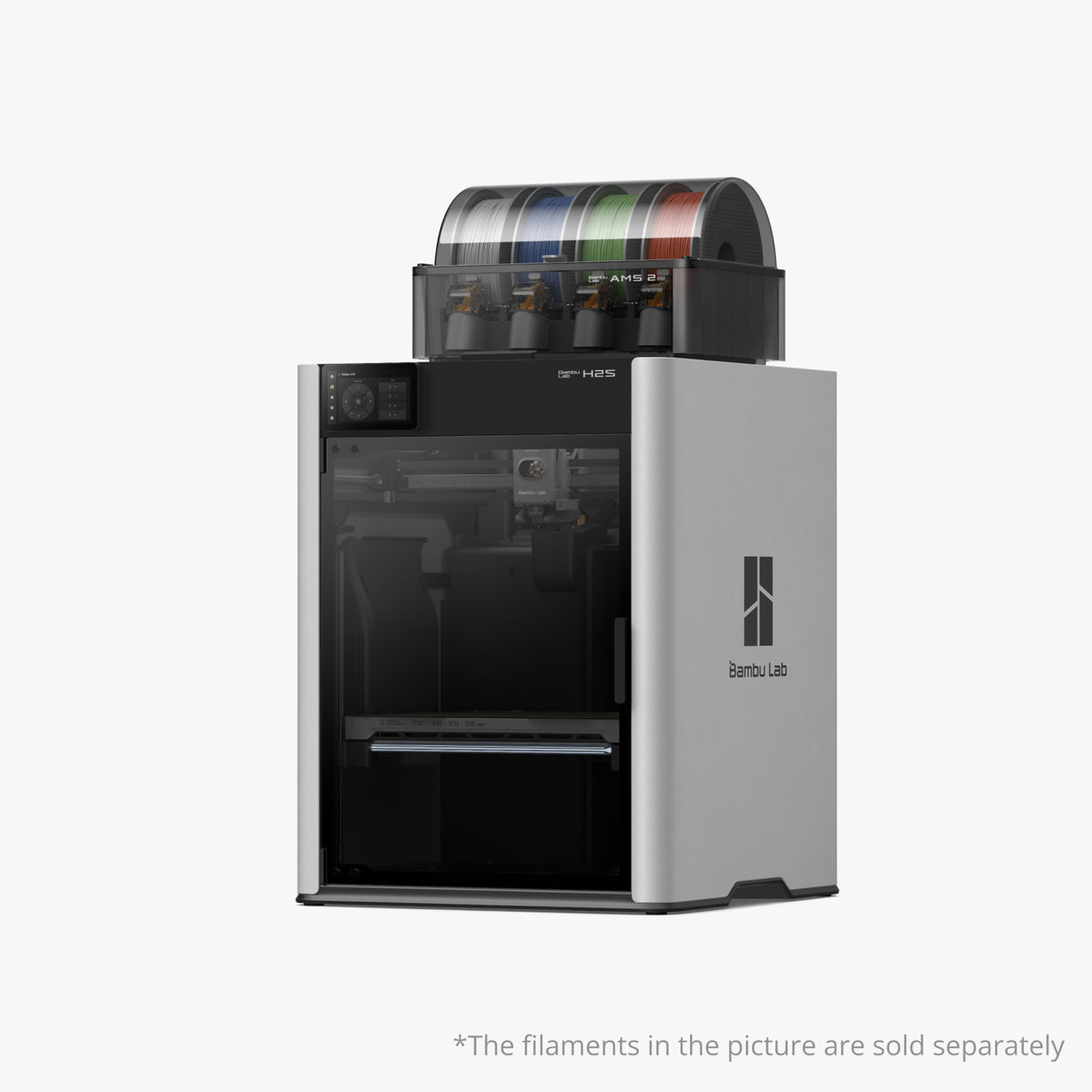
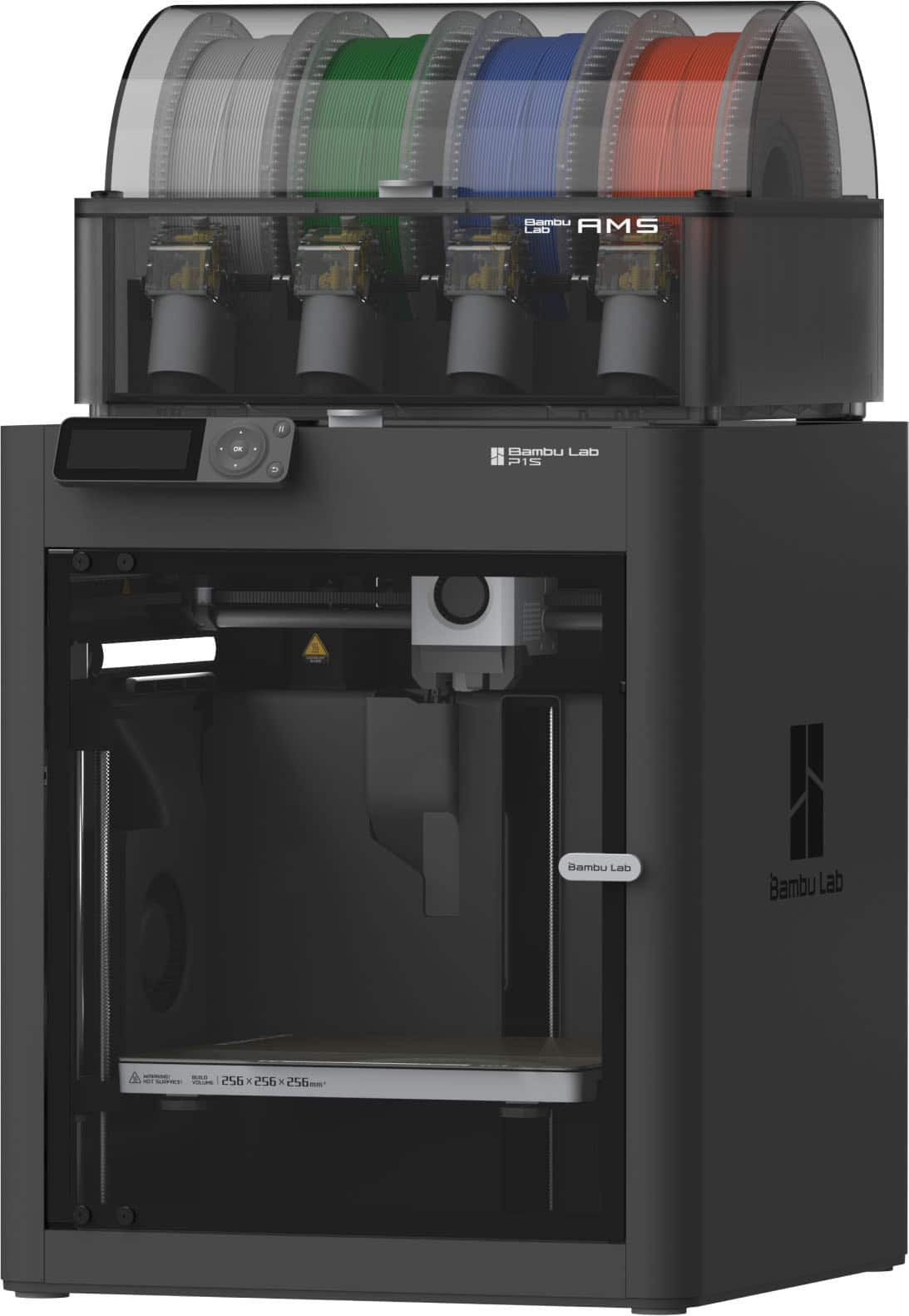
The Bambu Lab H2S is a 3D printer with a 340×320×340 mm³ build volume, the largest of any Bambu Lab printer. It prints in multiple colors with the AMS 2 Pro automatic material system. It can also be expanded with an optional 10W laser cutting and engraving module, a vinyl cutter attachment and pen drawing.
The hotend reaches 350°C and the chamber is actively heated to 65°C. This supports filaments from PLA and PETG to PC and PPA. Closed-loop fan control and thermal management help limit warping and improve layer adhesion. A flap switch airflow and filtration system has three modes: high-temp printing with a sealed chamber, low-temp printing with a filtered exhaust, and laser cutting or engraving with fumes channeled to the ventilation system.
The extruder uses a closed-loop PMSM servo system with 20 kHz resistance and position sampling. It detects grinding and clogs in real time and delivers 67% more extrusion force. The Vision Encoder keeps motion accuracy under 50 μm by automatically compensating for mechanical drift during calibration. Active Vibration Compensation reduces vibration and resonance at higher speeds. Before each print, an AI pre-flight checklist scans the chamber for debris and identifies the build plate.
- Build volume
- 340 × 320 × 340 mm³
- Hotend
- All-metal, up to 350°C
- Chamber
- Actively heated, up to 65°C
- Extruder
- Closed-loop PMSM servo motor, hardened steel extruder gear
- Speed
- Toolhead speed up to 1000 mm/s, acceleration up to 20,000 mm/s²
- Motion accuracy
- Under 50 μm with Vision Encoder
- Calibration
- 5μm resolution optical motion calibration
- Multi-color
- Supported with AMS 2 Pro
- Optional modules
- 10W laser cutting and engraving module, vinyl cutter, pen drawing