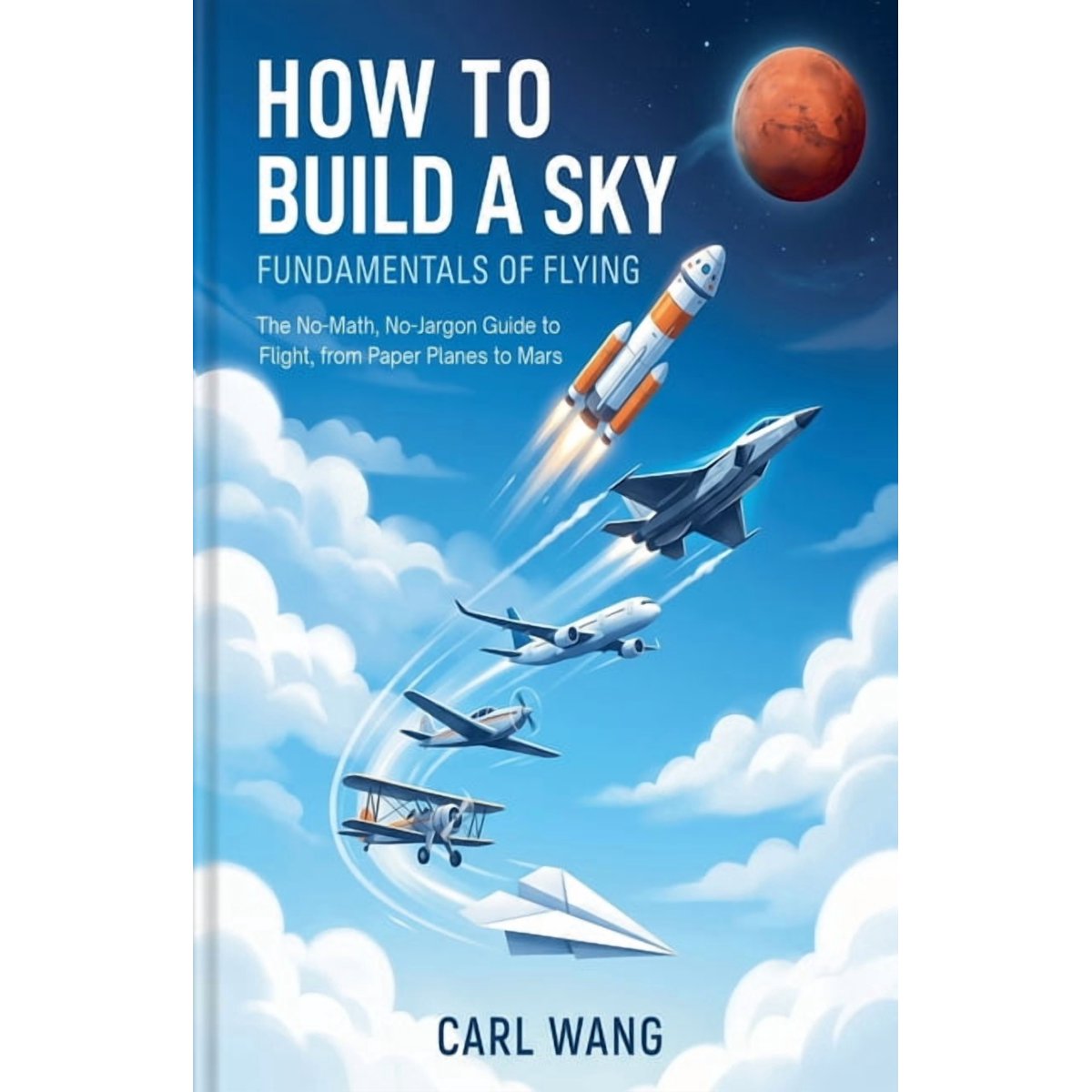
- Do I need a science or math background to follow it?
- No. The book is written without equations or jargon and builds each idea from everyday objects, so it assumes no prior knowledge.
- What age is it written for?
- The author targets curious readers ages 12 and up, so it works for teens and adults, though younger children may need help with some concepts.
- What topics does it cover?
- It starts with the four forces of flight and wing shape, then moves to jet engines, rockets, the International Space Station's orbit, instrument landings, hypersonic aircraft and Mars habitats.
- Is it like The Way Things Work or What If?
- It shares their plain, example-driven style, but it stays on one subject, flight and space engineering, rather than covering machines broadly or answering odd hypotheticals.
- Does it include experiments I can do at home?
- Yes. It uses a spoon and faucet, a hand out a car window and a stalling paper plane to demonstrate lift, drag and stalls, using ordinary household items.
- Does it cover space travel or only airplanes?
- Both. It explains why rockets carry their own oxygen, why astronauts float, and what living on Mars would require, alongside airplane flight.
- Where is the How to Build a Sky: Fundamentals of Flying: The No-Math, No-Jargon Guide to Flight, from Paper Planes to Mars cheapest?
- At Lulu Press, for $7.32, 27% under what the other stores charge, as of our latest check.
- Where can I buy the How to Build a Sky: Fundamentals of Flying: The No-Math, No-Jargon Guide to Flight, from Paper Planes to Mars?
- 6 stores we checked sell it, including Walmart, Lulu Press, Amazon, World of Books, Books A Million.