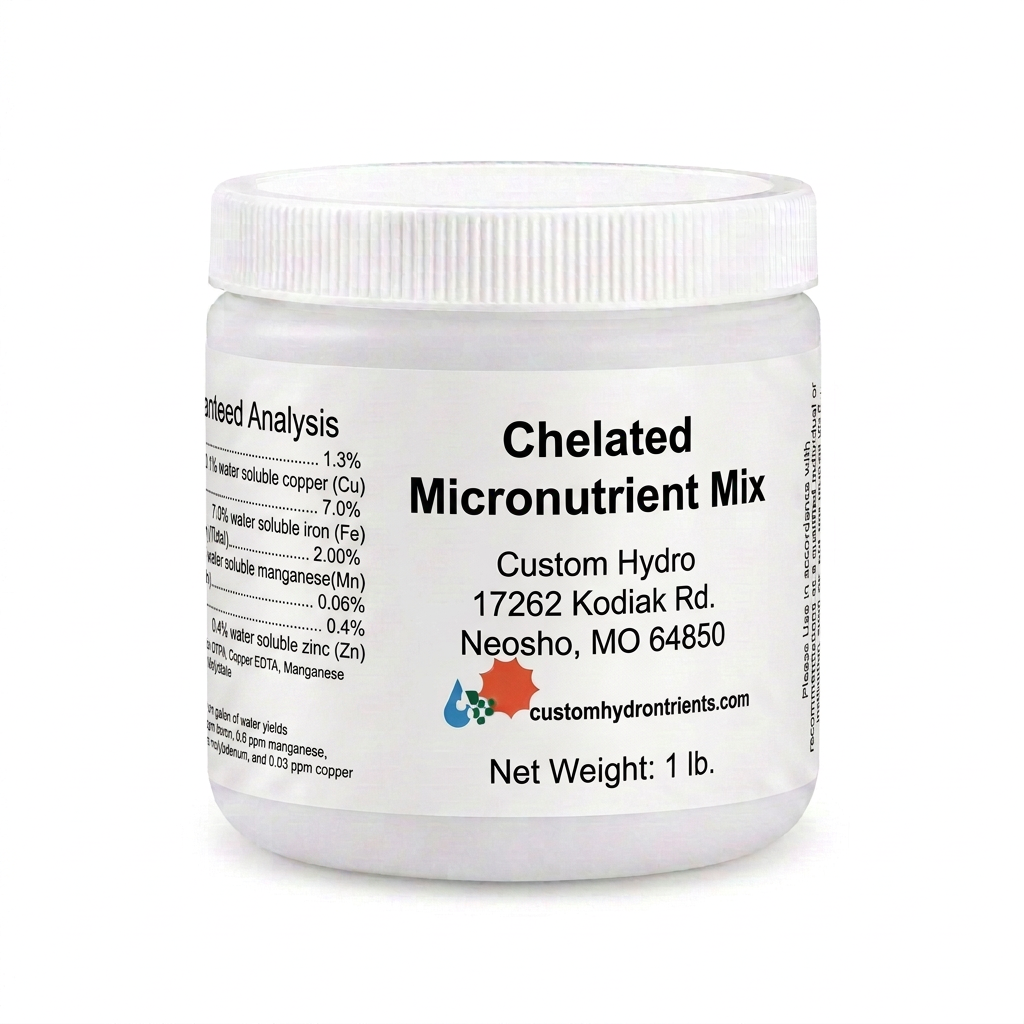
This is a water-soluble chelated micronutrient mix for crops grown in artificial and soilless media. It supplies iron, manganese, zinc, copper, boron and molybdenum in one blend. Iron, manganese, zinc and copper are in chelated forms.
It is a micronutrient supplement, not a complete fertilizer. Use it as the micronutrient part of a nutrient program, alongside sources of nitrogen, phosphorus and potassium. Account for micronutrients already in your water and other fertilizers. For agricultural or soil-grown greenhouse crops, use it as a supplement when soil tests show low micronutrient levels.
The general rate is 3 g per 100 L of water, about 0.114 g per US gallon. This is a general nutrient-solution rate, not a deficiency-correction or foliar rate. A scale suitable for small quantities is needed. For injector systems, mix 3 g/L of concentrate at a 1:100 ratio or 6 g/L at a 1:200 ratio to reach the same final concentration. Use only as recommended, because misuse may harm crops.
- Net weight
- 1 lb
- Packaging
- Resealable jar
- Form
- Water-soluble
- Chelated iron (Fe)
- 7%
- Chelated manganese (Mn)
- 2%
- Chelated zinc (Zn)
- 0.4%
- Chelated copper (Cu)
- 0.1%
- Boron (B)
- 1.3%
- Molybdenum (Mo)
- 0.06%
- Chelating agents
- EDTA 42%, DTPA 14%
- General rate
- 3 g per 100 L of water (about 0.114 g per US gallon)
- Nutrients at general rate
- Iron 2.1 ppm, manganese 0.6 ppm, zinc 0.12 ppm, copper 0.03 ppm, boron 0.39 ppm, molybdenum 0.018 ppm
- Injector rate
- 3 g/L at 1:100 or 6 g/L at 1:200
- Source
- Repack of Plant-Prod Chelated Micronutrient Mix, not original manufacturer packaging