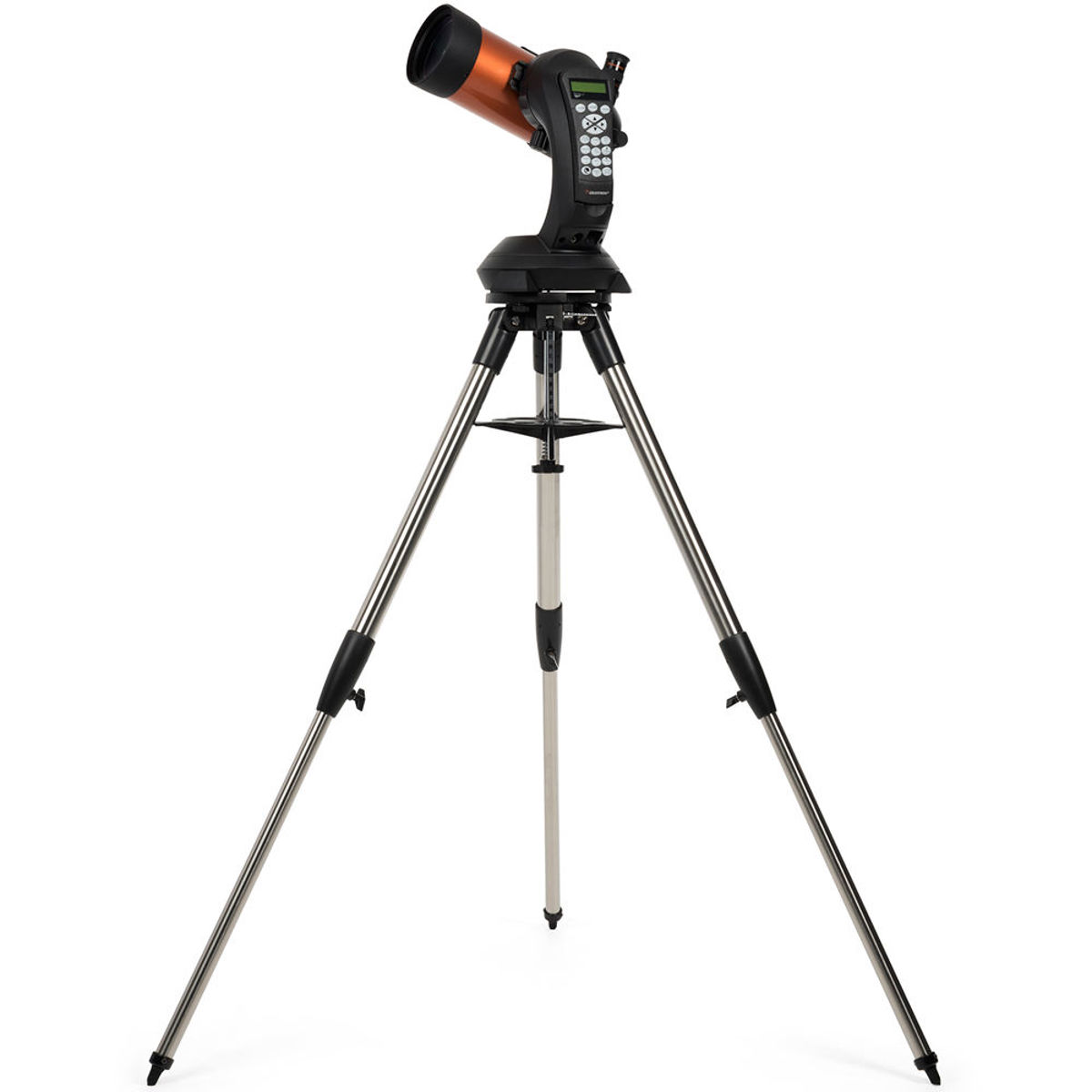
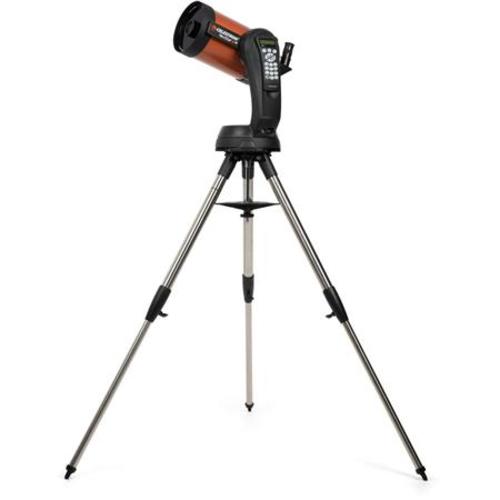
The Celestron NexStar 5SE is a computerized Schmidt-Cassegrain telescope with an orange tube and a five-inch primary mirror. Its optics gather enough light to observe Saturn's rings, the cloud bands on Jupiter and geographic features on the Moon. At a dark-sky site, it can also show deep sky objects such as the Hercules Globular Cluster and the spiral arms of the Whirlpool Galaxy.
The telescope uses a patented single fork arm mount. It breaks down into several lightweight, compact pieces for transport, including in small vehicles. The included NexStar+ hand control locates over 40,000 celestial objects and offers a Sky Tour of the best objects currently visible.
Alignment uses SkyAlign: center three bright objects in the eyepiece and press ALIGN. The telescope is compatible with the StarSense AutoAlign accessory for automatic alignment and the SkySync accessory for providing GPS coordinates. It has a built-in wedge for tracking long exposures, and it can be paired with NexImage cameras for imaging the Moon and planets.
- Telescope type
- Computerized Schmidt-Cassegrain
- Primary mirror
- 5 inches
- Mount
- Patented single fork arm mount, with built-in wedge
- Hand control
- NexStar+ (included), over 40,000 celestial objects, Sky Tour
- Alignment
- SkyAlign (center three bright objects, press ALIGN)
- Compatible accessories
- StarSense AutoAlign, SkySync GPS, NexImage cameras
- Portability
- Breaks down into several lightweight, compact pieces