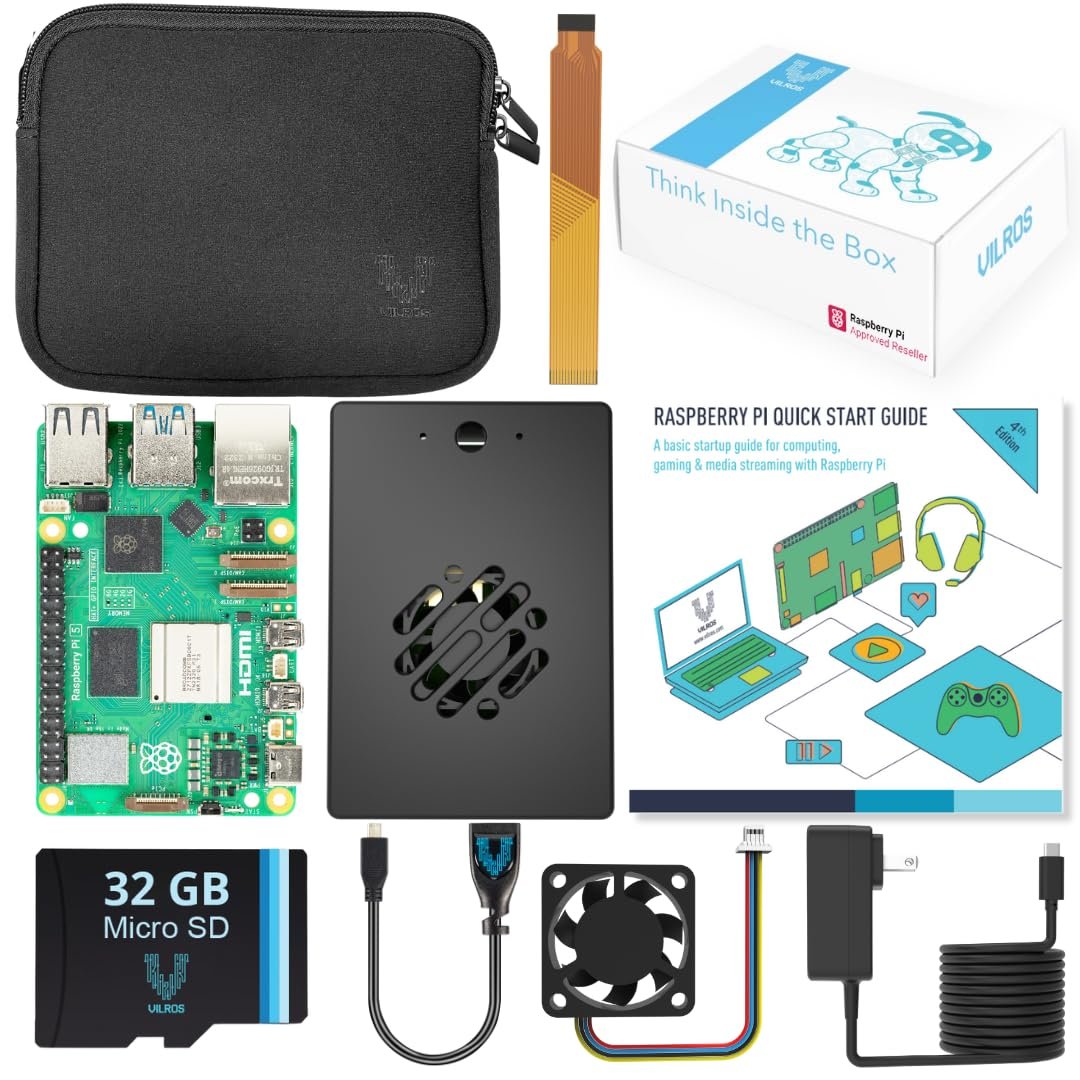
This starter kit is built around the Raspberry Pi 5 single-board computer with 4GB of RAM. The board has a Broadcom BCM2712 2.4GHz quad-core 64-bit Arm Cortex-A76 CPU and a GPU. The kit includes the parts needed to set it up, and a quickstart guide updated for the Pi 5 walks through assembly.
The aluminum alloy case cools the board both passively and actively. A heatsink touches the board, and a Pi 5 compatible PWM fan built into the case adjusts its speed based on temperature. The fan reaches up to 10k RPM. The case also has a built-in LED on/off button.
The kit can be used as a desktop computer replacement, a media hub, or a retro gaming setup. It can also run web servers, game servers such as Minecraft, Quake and Doom, a Plex server, home automation, a network-wide ad blocker, or a network monitoring tool. Other projects include controlling robots, time-lapse videos and stop-motion cameras. A keyboard, mouse and monitor are not included.
- Brand
- Raspberry Pi board, with Vilros kit components
- Type
- Single-board computer
- Memory
- 4GB RAM
- Processor
- Broadcom BCM2712 2.4GHz quad-core 64-bit Arm Cortex-A76
- Cooling
- Aluminum alloy passive and active cooling case with Vilros low noise PWM fan (up to 10k RPM, built into case)
- Storage
- 128GB Samsung EVO+ Micro SD card preloaded with Raspberry Pi OS (64-bit)
- Video output
- 2 x 5 ft Micro HDMI to HDMI cables, supports up to 4K 60p
- In the box
- Raspberry Pi 5 board, cooling case with LED on/off button, PWM fan, power supply, 128GB Micro SD card with Raspberry Pi OS, USB MicroSD card reader, 2 x Micro HDMI to HDMI cables, camera module adapte
- Camera support
- Mini to standard camera module adapter cable included