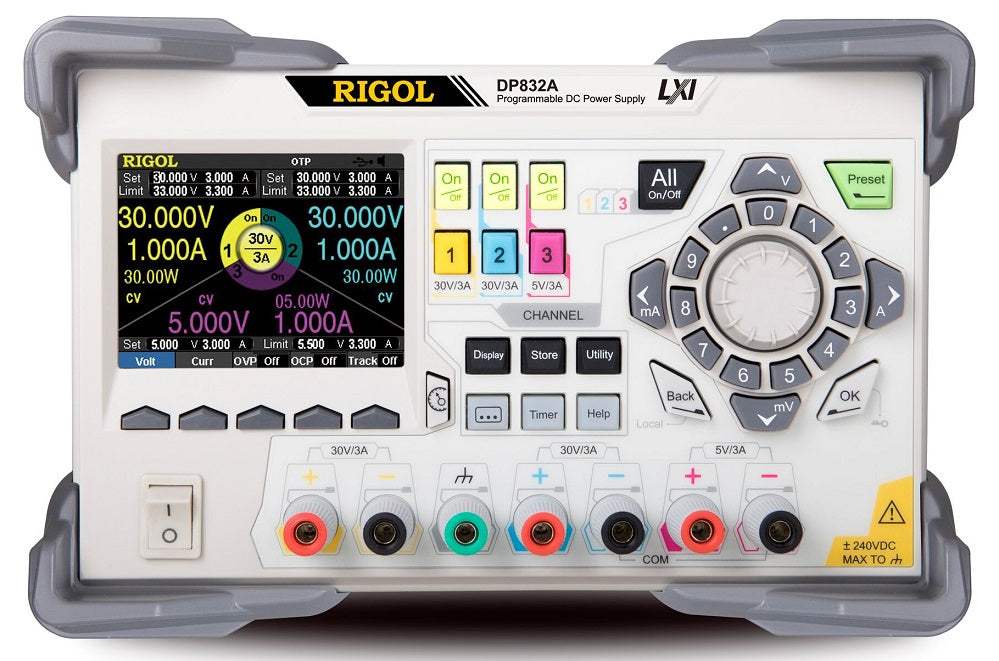
Rigol DP832A Triple-Channel Programmable Linear DC Power SupplyKey Features At A Glance
One to three output channels across the series; total output power spans 140 W to 200 W by model
Low normal-mode ripple and noise of <350 μVrms / 2 mVpp (20 Hz to 20 MHz)
Fast transient response under 50 μs, recovering to within 15 mV on a full-to-half load change
Load and linear regulation of <0.01% + 2 mV (voltage) and <0.01% + 250 μA (current)
Standard OVP, OCP, and OTP protection plus standard timing output on every model
Built-in V/A/W measurement and waveform display on a 3.5-inch TFT screen, with independent channel control
USB Host and Device standard; LAN, RS-232, and Digital I/O standard on A-suffix models; USB-GPIB optional
Timer and delay output standard; recorder, analyzer, monitor, and trigger standard on A models, optional on others
The RIGOL DP800 Series is a family of programmable linear DC power supplies offered in single-, dual-, and three-channel configurations. Built on a linear regulation topology, the series pairs clean, stable output with a 3.5-inch TFT display, built-in voltage/current/power measurement, and independent control of each channel. Some channels are isolated, and every model includes standard over-voltage, over-current, and over-temperature protection along with a standard timing output.RIGOL lists the DP800 Series for R&D lab general-purpose testing, quality control and assessment, supplying pure power for RF and microwave circuits or components, and powering automobile electronic circuit tests. Additional listed uses include production automation testing, device or circuit characteristic verification and troubleshooting, and educational experiments.ValueTronics supports the DP800 Series from our own 20,000-square-foot secure warehouse at 1675 Cambridge Drive in Elgin, Illinois, where we stock and hold our inventory directly.Compare Other Models in This SeriesThe RIGOL DP800 Series spans single-, dual-, and three-channel programmable linear DC power supplies. The three-channel DP832A/DP832 deliver outputs of 30 V/3 A, 30 V/3 A, and 5 V/3 A for total power up to 195 W; the three-channel DP831A/DP831 provide 8 V/5 A, 30 V/2 A, and −30 V/2 A for up to 160 W; the dual-channel DP821A/DP821 offer 60 V/1 A and 8 V/10 A with remote sense for up to 140 W; and the single-channel DP811A/DP811 provide 20 V/10 A (low range) or 40 V/5 A (high range) with remote sense for up to 200 W.Across the series, the A-suffix models include high-resolution setting and the LAN, RS-232, and Digital I/O interfaces as standard; on the non-A models these are available as options. All models share the same linear regulation performance, the OVP/OCP/OTP protection set, the 3.5-inch TFT display, and built-in measurement with waveform display.Each model in the series links to its own dedicated product page with new-matched pricing. Select the specific model and channel configuration that fits your application, and review that page for its individual specifications and current availability.The three-channel DP832A provides two 30 V/3 A outputs plus a 5 V/3 A output, with total output power up to 195 W. As an A-suffix model it includes high-resolution setting along with LAN, RS-232, and Digital I/O interfaces as standard, and provides recorder, analyzer, monitor, and trigger functions as standard.The primary differences across the family are channel count and output ratings. The DP832A/DP832 are three-output supplies (30 V/3 A, 30 V/3 A, 5 V/3 A, up to 195 W); the DP831A/DP831 are three-output supplies with a positive and a negative rail (8 V/5 A, 30 V/2 A, −30 V/2 A, up to 160 W); the DP821A/DP821 are dual-output with remote sense (60 V/1 A, 8 V/10 A, up to 140 W); and the DP811A/DP811 are single-output with two selectable ranges and remote sense (20 V/10 A or 40 V/5 A, up to 200 W).The second axis of difference is the A versus non-A designation: A-suffix models include high-resolution setting and the LAN/RS-232/Digital I/O interface set as standard, while the non-A models offer these as options (for example HIRES-DP800, INTERFACE-DP800, and DIGITALIO-DP800). The comparison table below details the per-model voltage, current, power, and interface differences.