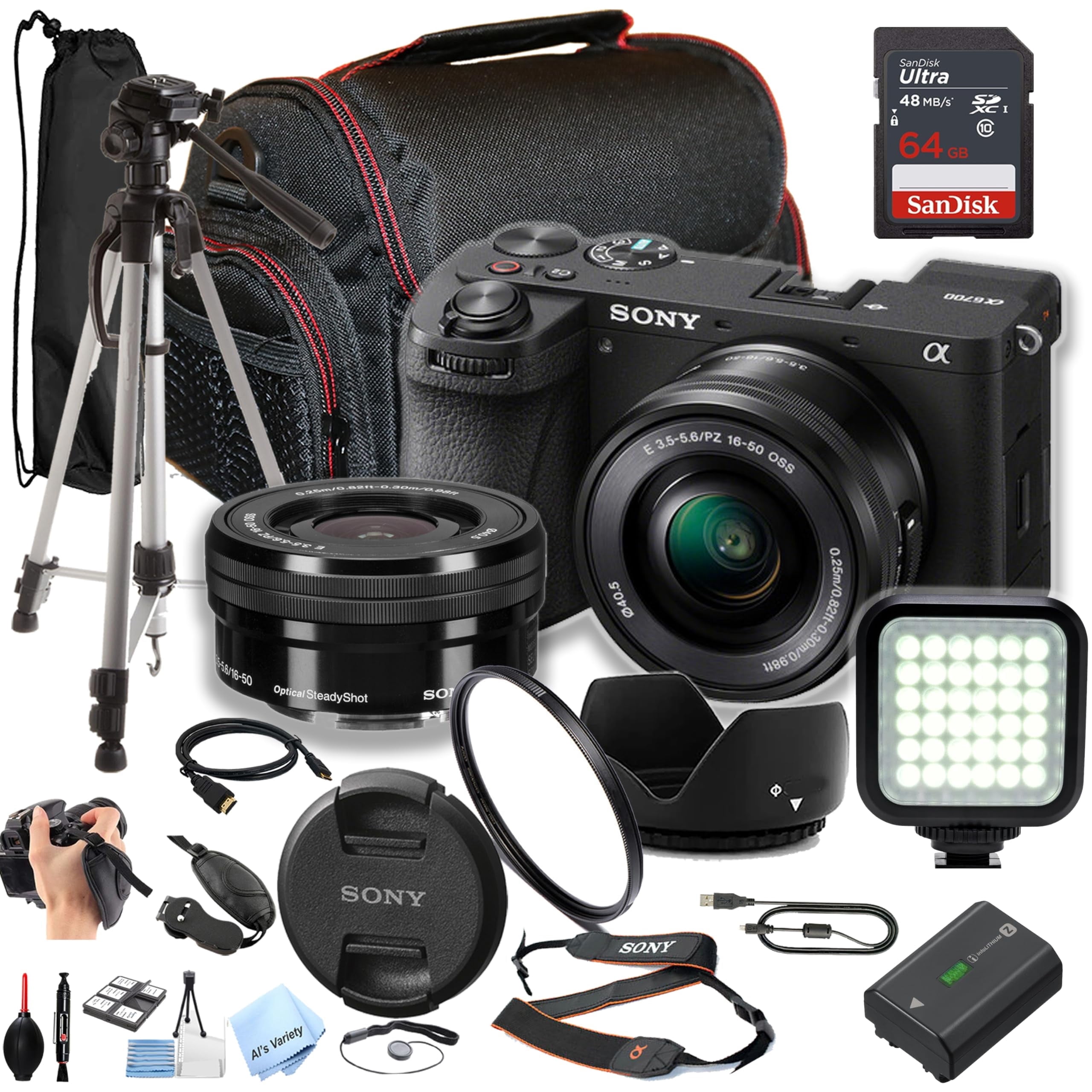
Sony Alpha a6700 Mirrorless Camera with 16-50mm II Lens
Best price now
Prices are checked against each store and labelled with when.
Finding cheaper alternatives
Price facts
- Lowest price today: $1,598.00 at Pictureline (checked Nov 19, 2026).

Prices are checked against each store and labelled with when.
The Sony Alpha a6700 is a compact APS-C mirrorless camera built around a 26MP back-illuminated Exmor R sensor and the BIONZ XR processor borrowed from Sony's Cinema Line. It shoots 10-bit 4K up to 120 fps, bursts at 11 fps with autofocus and auto exposure, and adds AI-based subject recognition for people, animals and vehicles. It is smaller and lighter than the a6600 it replaces, and its stabilized body, flip-out screen and long battery life make it a strong hybrid for creators who want one camera for stills and video. Rivals like the Fujifilm X-S20 and Canon EOS R10 undercut it on some video specs, but the a6700's autofocus tracking and lens ecosystem are its main advantages.
In stockReturn policy
Owners and reviewers treat the a6700 as one of the best APS-C hybrids for autofocus and video, praising its subject tracking, 4K quality and stabilization. Common complaints are rolling shutter in video, the single card slot and a body that feels cramped with big lenses.
The Sony Alpha a6700 is a mirrorless camera built around a 26.0MP APS-C back-illuminated Exmor R CMOS sensor and the BIONZ XR processor, the same combination introduced in the FX30 Digital Cinema Camera. The back-illuminated sensor structure is paired with an ISO range of 100-32000, expandable to 50-102400 for stills, and more than 14 stops of dynamic range.
Video is recorded in UHD 4K at frame rates up to 120p and in Full HD up to 240p, with full 1:1 pixel readout and no binning. The camera reads out the full width of its 6K sensor for 4K, capturing about 2.4x the data 4K needs to limit moiré and aliasing. XAVC HS and XAVC S-I formats record 10-bit 4:2:2 at bitrates up to 600 Mb/s, and the Slow & Quick mode runs 4K between 1 and 120 fps and Full HD between 1 and 240 fps.
A pixel-level 5-axis optical image stabilization system compensates for five types of camera shake in stills and video. An AI processing unit handles subject recognition and tracking, with adjustments for tracking speed and sensitivity, auto-cropping, touch adjustment of the tracked subject, and custom framing location. Stills can be shot at up to 11 fps with autofocus and auto exposure, in bursts of up to 59 compressed raw images.
It checks today's price at every store, compares the alternatives and answers in about a minute.