StoreDeal.ai store
Shop
  • Deals
  • Deal checker
  • Black Friday
  • Buying guides
  • Brands
  • Stores
Travel
  • Flight deals
  • Hotel deals
Company
  • Research
  • Press
  • Use in AI assistants
  • Contact
  • deal.ai apps
Black Friday 2026
  • Walmart
  • Best Buy
  • Target
  • TVs
  • Laptops
  • Headphones
  • Apple
  • Gaming
  • Vacuums
  • Kitchen
  • Toys
  • Smartwatches
  • Tablets
  • Furniture
  • Mattresses
© Deal.ai Inc.·2222 Ponce de Leon Blvd, Miami, FL 33134·support@deal.ai
TermsPrivacy
Deal.ai › Compare

AGM ObservIR LRF 35-640 Thermal Binoculars vs Pulsar Symbion LRF DXT50

The Pulsar Symbion LRF DXT50 is the stronger optic: its 1280x1024 thermal sensor resolves far more detail and detects heat past 2,500 yards, against 640x512 in the AGM ObservIR LRF 35-640. The AGM counters with a lighter, simpler binocular that runs on standard 18650 cells you can swap in the field. Owners of the Pulsar praise the image and stabilization but warn the controls take practice to run in the dark; the AGM is easier to learn and cheaper to own over time. Buy the Pulsar for maximum reach and detail, the AGM for a lighter, simpler multispectral setup.

  • Choose the AGM ObservIR LRF 35-640 if you want a lighter multispectral binocular with a simple control layout and standard 18650 batteries you can swap in the field.
  • Choose the Pulsar Symbion LRF DXT50 if you need the longest detection range and the most thermal detail, and will put in the time to learn its controls.

Prices

  • AGM ObservIR LRF 35-640 Thermal Binoculars: $2,995.00 at Night Vision Universe (last seen Nov 8)
  • Pulsar Symbion LRF DXT50: $7,999.97 at MidwayUSA (last seen Nov 13)
  • Difference: the AGM ObservIR LRF 35-640 Thermal Binoculars is $5,004.97 cheaper than the Pulsar Symbion LRF DXT50 at the latest prices (Nov 8 and Nov 13)
AGM
AGM ObservIR LRF Thermal Binoculars 35-640

AGM ObservIR LRF 35-640 Thermal Binoculars

AGM ObservIR LRF Thermal Binoculars 35-640

5(1 rating)
$2,995.00at Night Vision UniverseChecked Nov 8
See all prices and details
Visit Night Vision Universe
Pros
  • 640x512 thermal plus a 4K digital day/night channel
  • Built-in rangefinder, GPS and Wi-Fi
  • Runs on removable 18650 cells, four in the box
  • IP67 waterproof and lighter to carry
Cons
  • Lower thermal resolution than the Pulsar
  • Shorter detection range from the 35 mm lens
  • No image stabilization listed
  • Less thermal zoom flexibility
Pulsar
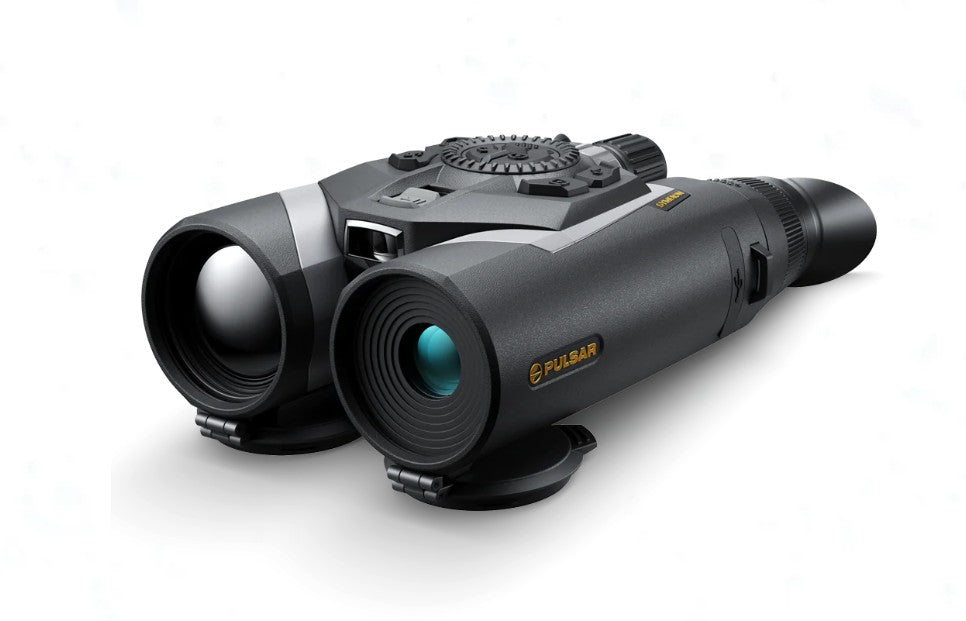
Pulsar Symbion LRF DXT50

Pulsar Symbion LRF DXT50

5(3 ratings)
$7,999.97at MidwayUSAChecked Nov 13
See all prices and details
Visit MidwayUSA
Pros
  • 1280x1024 thermal sensor with under 40 mK sensitivity
  • Detection past 2,500 yards
  • 2-14x thermal and 6.5-26x digital magnification
  • Image stabilization, AMOLED display and 64GB storage
Cons
  • Heavier, bulkier 50 mm build
  • Controls take time to learn for dark use
  • Eyecup protectors get in the way for some owners
  • Battery is a proprietary pack, not standard cells

What separates them

AGM ObservIR LRF 35-640 Thermal BinocularsPulsar Symbion LRF DXT50
Thermal sensor resolution640x512, 12 micron, 50 Hz1280x1024, 12 micron, 50 Hz
Thermal detection rangeShorter reach from the 35 mm lens2,500 yards and beyond
Objective lens35 mm germanium, F1.050 mm germanium, F1.0
Thermal magnificationUp to 4x digital zoom on a fixed base2-14x thermal, 6.5-26x digital
Laser rangefinderUp to 1,000 metersUp to about 1,500-1,600 yards
Image stabilizationNot listedBuilt-in stabilization
BatteryRemovable 18650 cells, up to 8 hours, four includedRechargeable AP5 pack, two included
Weight and bulkLighter, more compact 35 mm bodyHeavier magnesium alloy build with a 50 mm lens

Price history

  • Pulsar Symbion LRF DXT50: lowest $7,999.97 on Nov 13 at MidwayUSA.

Prices at every store

AGM ObservIR LRF 35-640 Thermal Binoculars

  • Night Vision UniverseNew

    In stockReturn policy

    $2,995.00Checked Nov 8
    Visit Night Vision Universe
Prices and history →

Pulsar Symbion LRF DXT50

  • MidwayUSANew

    In stock

    $7,999.97Free shippingChecked Nov 13
    Visit MidwayUSA
  • ScheelsNew

    In stock

    $7,999.97Free shippingChecked Nov 13
    Visit Scheels
  • Natchez Shooting & OutdoorNew

    In stock

    $7,999.97Free shippingChecked Nov 13
    Visit Natchez Shooting & Outdoor
  • eBayNew

    Availability unknownSold by euroopticltd

    $7,999.97Checked Nov 13
    Visit eBay

Store links may earn us a commission.

All 11 stores and price history →

Specs compared

SpecAGM ObservIR LRF 35-640 Thermal BinocularsPulsar Symbion LRF DXT50
Sensors—1280 x 1024 12µm (thermal), 3840 x 2160 (digita…
Objective Lends Diameter—50mm
Magnification—2-14x (thermal), 6.5-26 (digital)
Thermal Detection Range—2,500 yards+
Rangefinder Max Range—1,600 yards
Battery—Rechargeable AP5 (2 included)

What reviewers say

Pulsar Symbion LRF DXT50

Owners rate the Symbion's thermal, digital and night performance as a major step up, with image stabilization and rugged build called out as strengths. Most criticism centers on the learning curve and fiddly eyecup protectors.

What people mention
  • Image qualityPraisedOwners call the thermal and digital channels a game-changing step up in detail.
  • Image stabilizationPraisedReviewers count stabilization as a real plus for long handheld observation.
  • ControlsCriticisedUsers say the many controls take a while to learn before dark use becomes easy.
  • Eyecup protectorsCriticisedSome owners find the eyecup protectors get in the way in the field.

Questions and answers

Which is better for long-range spotting?
The Pulsar. Its 1280x1024 sensor and 50 mm lens detect heat past 2,500 yards, well beyond the AGM's 640x512 sensor and 35 mm lens.
Which is easier to use in the dark?
The AGM. Owners of the Pulsar say its many controls take practice to run without light, while the AGM's layout is simpler to learn.
Does either have image stabilization?
Only the Pulsar lists built-in image stabilization. The AGM does not, so hand-held viewing at high zoom is steadier on the Pulsar.
Which has the better battery setup for a long trip?
The AGM. It runs on removable 18650 cells and ships with four, so you can swap power in the field. The Pulsar uses a rechargeable AP5 pack.
Is the Pulsar worth stepping up to over the AGM?
Yes if range and detail matter most: double the thermal resolution, a larger lens and stabilization are real gains. The AGM wins on weight, simplicity and field-swappable batteries.
Do both have a laser rangefinder and a digital channel?
Yes. Both pair a thermal channel with a 4K digital day/night channel and a built-in rangefinder; the Pulsar's rangefinder reaches farther.

Ask our shopping agent

It checks today's price at every store, compares the alternatives and answers in about a minute.

Enter to send, Shift+Enter for a new line

More comparisons

  • Thermal Master DV2 Thermal Night Vision Binoculars vs Pulsar Symbion LRF DXT50
  • Pulsar Symbion LRF DXT50 vs TS004
  • Thermal Master DV2 Thermal Night Vision Binoculars vs AGM ObservIR LRF Thermal Binoculars 35-640
  • Nocpix Quest S50R RF Thermal Bino vs AGM ObservIR LRF Thermal Binoculars 35-640
  • AGM ObservIR 25-256 4.5-18x LRF Thermal Binoculars vs Pulsar Symbion LRF DXT50
  • Nocpix Quest S50R RF Thermal Bino vs Pulsar Symbion LRF DXT50