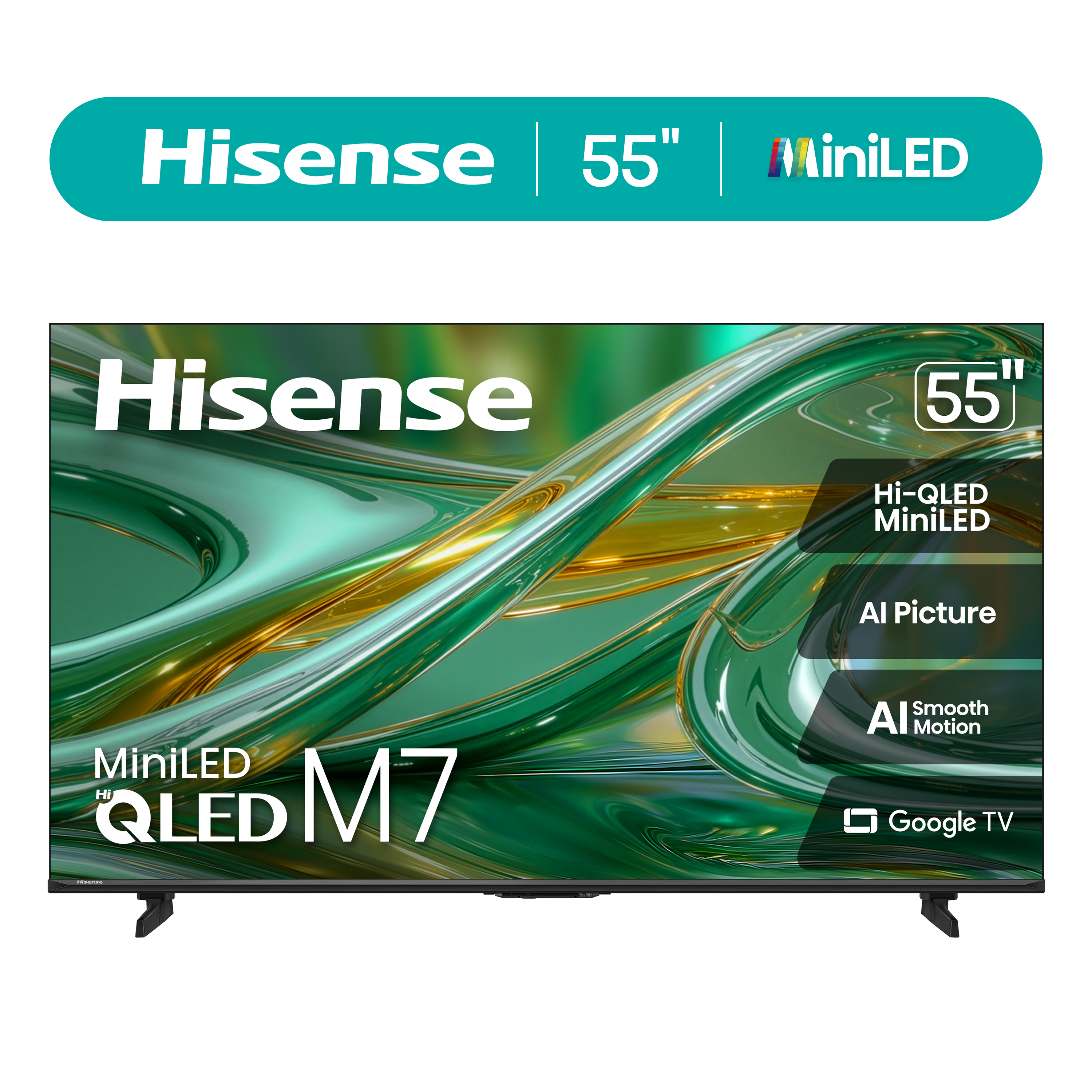
- Which is better for a bright living room?
- The Panasonic W85C. Its Glare Free Ultra low-reflection screen handles window light better, though its 500 nits is half the Hisense's 1000 nits. The Hisense wins on raw brightness but has no anti-glare coating listed.
- Which is better for gaming?
- The Panasonic, for consoles that support it. It has HDMI 2.1, ALLM, VRR, and a 120Hz OverClock mode. The Hisense runs at 60 Hz with Game Mode Plus, which reduces lag but cannot match 120 Hz.
- Is the Hisense worth it over the Panasonic?
- Yes if brightness and sound matter most. It is twice as bright as the Panasonic and has a built-in subwoofer. The Panasonic makes more sense if reflections are your main problem or you need HDMI 2.1 for a console.
- Which has better sound out of the box?
- The Hisense M7. It has 10 W x 2 speakers plus a 20 W subwoofer and Dolby Atmos. The Panasonic lists Dolby Atmos but no subwoofer, so it will sound thinner on bass.
- Do both run Google TV?
- Yes. Both use Google TV with Google Assistant, so the app selection and voice control are the same. The difference is in the panel and ports, not the software.
- Which has more HDMI ports?
- The Hisense, with four. The Panasonic has three, but they are HDMI 2.1, which matters for 4K 120 Hz consoles.
- Which lasts longer?
- Neither maker publishes a panel lifespan, so there is no clear winner. Both are 2026 models with the same 60 Hz native panel. The Panasonic's anti-glare coating and HDMI 2.1 ports are the more future-proof extras.
- Is the Panasonic worth stepping up to?
- Only if reflections or console gaming drive your choice. Its Glare Free Ultra screen, HDMI 2.1, VRR and ALLM are real advantages. For brightness and built-in bass, the Hisense does more.