- Will it work with an Arduino or ESP32?
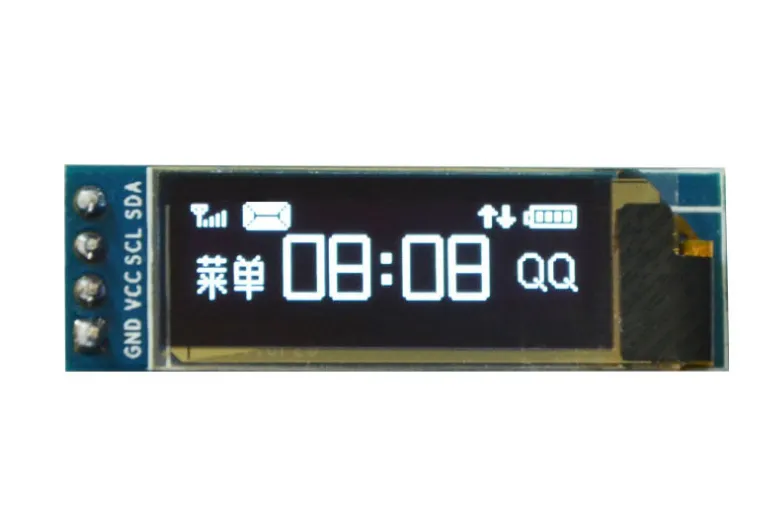
- Yes. It uses standard I2C on SCL and SDA, so it works with Arduino, ESP32 and Raspberry Pi boards. You need a library such as U8g2 or the Adafruit SSD1306 library, and the correct I2C address set in code.
- How is it different from a 0.96-inch OLED module?
- The 0.96-inch modules are usually 128x64 and show more lines. This one is 0.91 inch at 128x32, so it is smaller and shows roughly half the vertical pixels, which suits short status readouts rather than menus.
- What do the four pins do?
- GND is ground, VCC is power, SCL is the I2C clock and SDA is the I2C data line. Only two signal wires are needed, which leaves other pins free on the microcontroller.
- Can I change the brightness?
- Yes. Brightness and contrast are adjustable, so you can dim the display for dark rooms or brighten it for daylight.
- Does it need a backlight?
- No. OLED pixels emit their own light, so there is no backlight. Black areas stay unlit, which keeps contrast high and power draw low.
- What comes in the box?
- The module itself, with a four-pin header along one edge and a second four-pin header on the back of the board. Check the buy box for what is included with the option you pick.
- Where is the 0.91 Inch I2C OLED Display Module cheapest?
- At Deal.ai, for $8.99, as of our latest check.