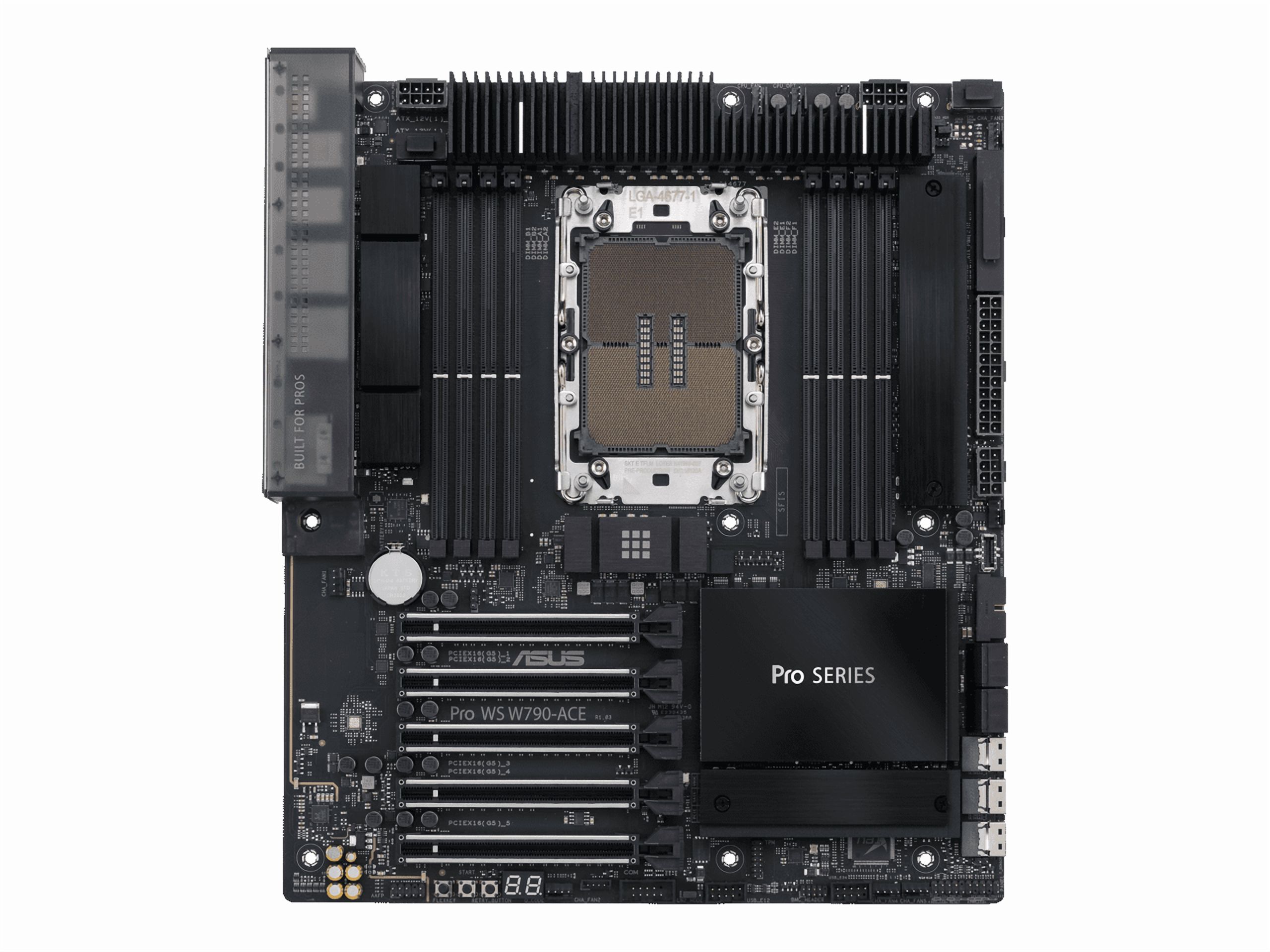
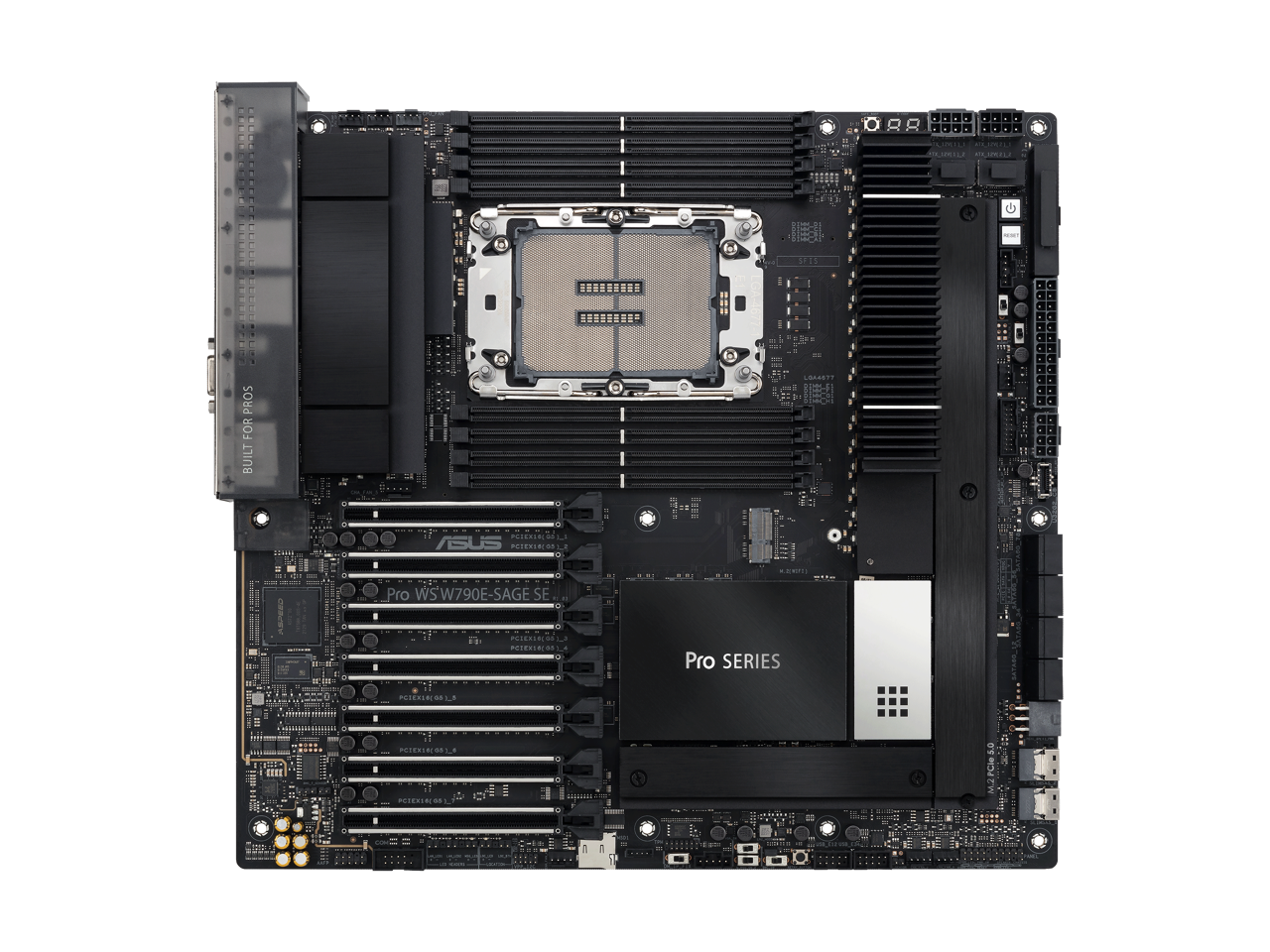
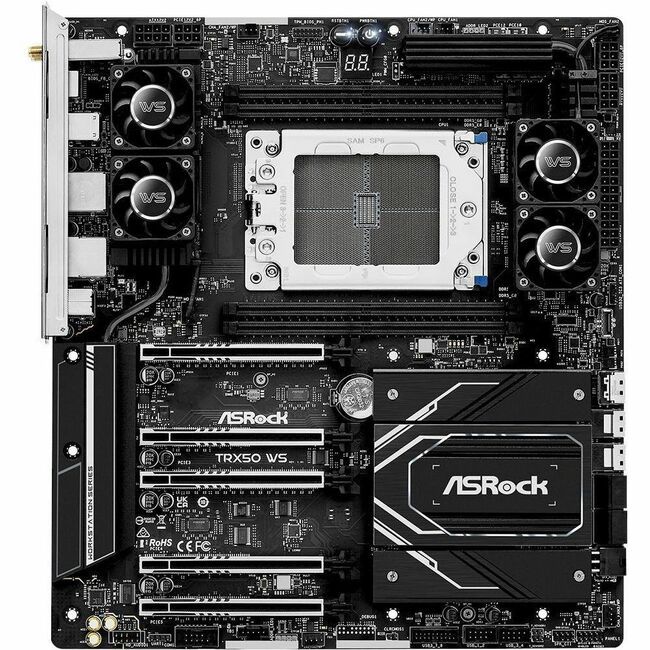
The ASUS WS X299 Sage is a workstation motherboard for Intel Core X-series processors, with support for up to 18 cores. It has dual PLX chips that add PCIe lanes, so it fits up to four dual-slot graphics cards. It supports NVIDIA SLI and AMD CrossFireX 4-way configurations, and is aimed at workloads such as neural network training, rendering and simulation.
Cooling uses a VRM heatsink with a metal fin array, plus an additional heatsink connected by a heatpipe. A separate heatsink array and heatpipe cover the PLX chips and reduce their temperatures by up to 20° C. Fan settings can be configured through Fan Xpert 4 or the UEFI BIOS. ASUS 5-Way Optimization tunes overclocking and cooling profiles for the installed system in one click.
A dedicated base-clock generator (ASUS PRO Clock II) extends CPU and memory overclocking margins. Third-generation T-Topology supports memory speeds of DDR4-4200MHz and beyond. ASUS Control Center provides centralized IT management, including remote BIOS updates and monitoring of multiple systems. The UEFI BIOS has EZ and Advanced modes and can be controlled with a mouse.
- Processor support
- Intel Core X-series, up to 18 cores
- Multi-GPU
- Up to four dual-slot graphics cards; NVIDIA SLI and AMD CrossFireX 4-way
- PCIe expansion
- Dual PLX chips extend the number of PCIe lanes
- Memory speed
- DDR4-4200MHz and beyond
- M.2 storage
- 2 onboard M.2 slots, each PCI Express 3.0 x4 (32Gbps)
- U.2
- Dual U.2 connectors, up to 32Gbps
- RAID
- Intel Virtual RAID on CPU (VROC) for bootable CPU-lane RAID arrays
- Optane
- Intel Optane memory ready
- USB
- USB 3.1 Gen 2 Type-A and Type-C ports, up to 10Gbps; USB 3.1 front-panel connector