StoreDeal.ai store
Shop
  • Deals
  • Deal checker
  • Black Friday
  • Buying guides
  • Brands
  • Stores
Travel
  • Flight deals
  • Hotel deals
Company
  • Research
  • Press
  • Use in AI assistants
  • Contact
  • deal.ai apps
Black Friday 2026
  • Walmart
  • Best Buy
  • Target
  • TVs
  • Laptops
  • Headphones
  • Apple
  • Gaming
  • Vacuums
  • Kitchen
  • Toys
  • Smartwatches
  • Tablets
  • Furniture
  • Mattresses
© Deal.ai Inc.·2222 Ponce de Leon Blvd, Miami, FL 33134·support@deal.ai
TermsPrivacy

Free shipping on everything·10% off your first order·No account needed · Buy 2, save 10% · 3+, save 15%

Deal.ai › Store › Tech & Gadgets › Cables & Parts
L
LM2596 Adjustable DC-DC Step-Down Module with Voltmeter

LM2596 Adjustable DC-DC Step-Down Module with Voltmeter

Sold and shipped by Deal.ai

$7.99Free shipping

$7.19 with 10% off your first order

Buy 2, save 10% · 3+, save 15%

Model: LM2596
How many?
1
  • 30-day money-back guarantee
  • Secure checkout

Arrives about Nov 28 – Dec 8, from a warehouse in China

30-day full refund: if you're not happy with it for any reason, or it never arrives, tell us within 30 days and we refund you in full. Shipping and refunds

Ask our agent about this product

It checks today's price at every store, compares the alternatives and answers in about a minute.

Enter to send, Shift+Enter for a new line

Price facts

  • Lowest price today: $7.99 at Deal.ai (checked Nov 21, 2026).

Our take on the LM2596 Adjustable DC-DC Step-Down Module with Voltmeter

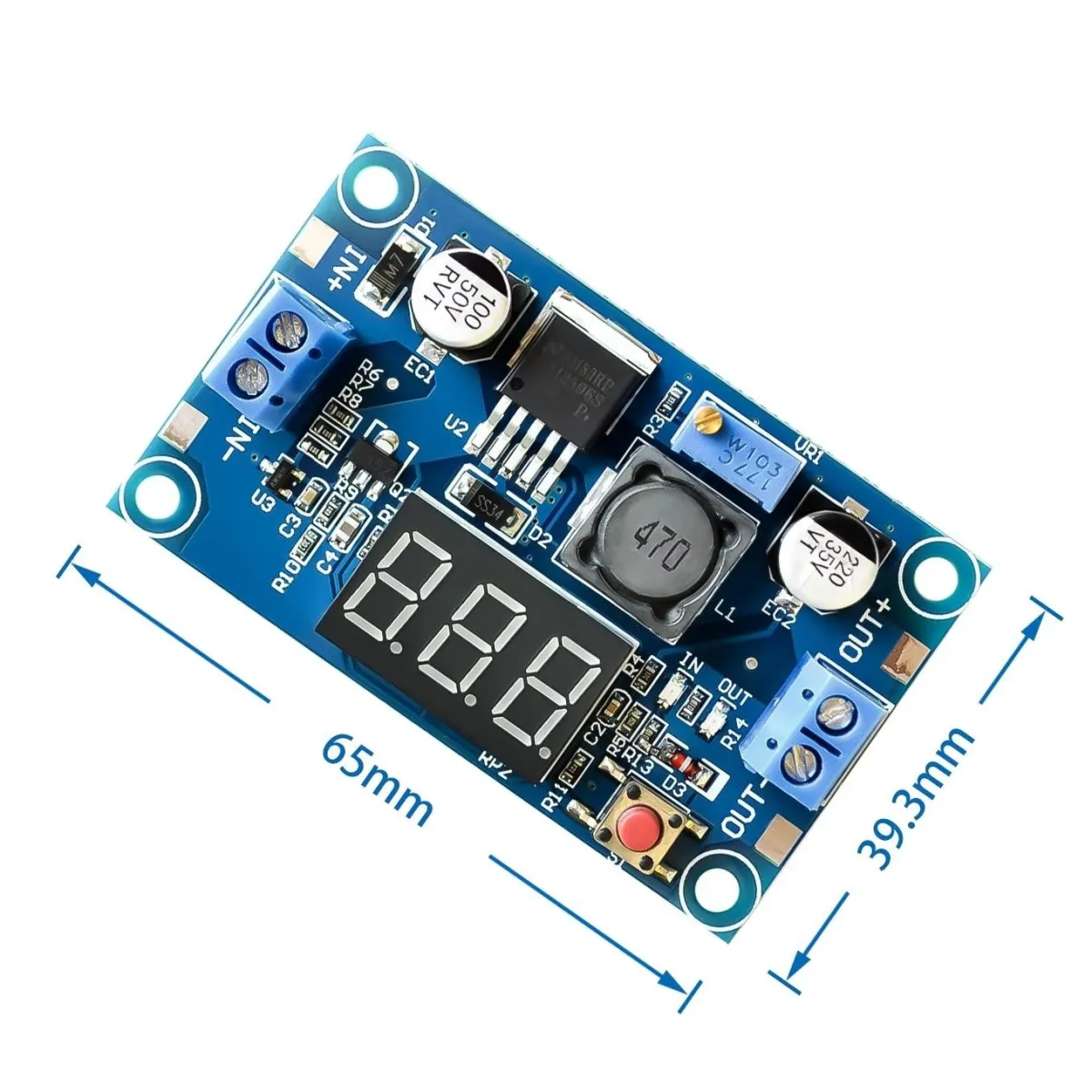
This is a small blue DC-DC buck converter board built around the LM2596 regulator, with screw terminals for input and output wiring and a three-digit red LED voltmeter on board. The output is continuously adjustable from 1.25 V to 37 V from an input of 4.0 V to 40 V, as long as the input stays at least 1.5 V above the output. It suits hobbyists, repairers and small projects that need a settable supply without soldering. Against plain LM2596 boards it adds the meter, a button to switch between input and output readings, and reverse, overheat and short-circuit protection; against switching modules with higher current ratings it is limited to about 2 A in practice.

Best forBreadboard and hobby projects needing a settable voltageBench testing and repair workPowering 12 V or 5 V devices from a higher supplyAnyone who wants to see the voltage without a separate multimeter
Pros
  • On-board voltmeter reads input or output with one button press
  • Screw terminals take bare wire, no soldering iron needed
  • Wide output range, 1.25 V to 37 V, continuously adjustable
  • Reverse, overheat and short-circuit protection built in
  • Meter setting is remembered after power-off
  • Solder pads kept for permanent wiring
Cons
  • Rated 3 A but recommended to stay within 2.0 A
  • Needs extra heatsinking above 15 W output
  • Input must be at least 1.5 V above the output
  • Meter needs input above 4.5 V to be accurate
  • Efficiency averages 88% and drops with a large voltage difference

What reviewers say

Owners of LM2596 modules like this one generally find them easy to wire and handy for quick voltage setting, and the built-in meter saves reaching for a multimeter. The common complaints are heat at higher currents and the real-world limit well under the 3 A rating.

What people mention
  • HeatCriticisedOwners report the board runs hot at higher currents and needs airflow or a heatsink.
  • Current limitCriticisedUsers say the usable current is around 2 A, not the 3 A on the label.
  • VoltmeterPraisedThe on-board display is seen as a handy way to set and check output voltage.
  • WiringPraisedScrew terminals are liked for hooking up wires without soldering.
  • Voltage dropMixedSome note the output sags under load or with a large input-to-output difference.

About the LM2596 Adjustable DC-DC Step-Down Module with Voltmeter

This is an adjustable DC-DC step-down module built on a rectangular circuit board with screw terminals for the input and output wiring. It takes an input of 4.0 to 40 V and gives a continuously adjustable output of 1.25 to 37 V; the input must stay at least 1.5 V above the output. Output current is 3 A, with use within 2.0 A recommended, and output power is 20 W.

An on-board voltmeter with a touch button switches the display between the input and output voltage and lights an indicator for the one being read. The setting is saved when the power is turned off, and the display can be switched off when it is not needed. The voltmeter reads 0 to 40 V with an error of ±0.05 V, and the input should be above 4.5 V for accuracy.

Conversion efficiency averages 88%. The module has reverse connection, overheating and short circuit protection. The wiring terminals take the connections without a soldering iron, and bonding wire wiring points are also kept on the board. Above 15 W output, heat dissipation should be improved.

Model
LM2596
Type
DC-DC adjustable step-down module
Input Voltage
4.0–40 V, at least 1.5 V above output
Output Voltage
1.25–37 V, continuously adjustable
Output Current
3 A, recommended within 2.0 A
Output Power
20 W, enhance heat dissipation above 15 W
Efficiency
Average 88% (depends on input, output, current and differential pressure)
Voltmeter
0–40 V range, ±0.05 V error, input above 4.5 V for accuracy
Display
On-board voltmeter with touch button to switch input/output voltage and indicator light
Protection
Reverse connection, overheating and short circuit
Specifications

Model
LM2596
Type
DC-DC adjustable step-down module
Output voltage
1.25–37 V continuously adjustable
Output current
3 A (recommended within 2.0 A)
Output power
20 W (enhance heat dissipation above 15 W)
Conversion efficiency
Average 88%
Voltmeter range
0–40 V, error ±0.05 V

Questions and answers

What input voltage does it need?
Anywhere from 4.0 V to 40 V, and always at least 1.5 V above the output you set. The meter needs more than 4.5 V input to read accurately.
How much current can it deliver?
It is rated 3 A, but the maker recommends staying within 2.0 A. Above 15 W output you should add heatsinking.
Can I set the output without a multimeter?
Yes. The on-board voltmeter shows input or output voltage, switched with the button, so you can adjust the trimmer and read the result directly.
Does it need soldering?
No. Wires go into the screw terminals at each end. Solder pads are also kept on the board for permanent connections.
What is in the box?
One module. No wires, heatsink or instructions are included.
Is it a boost converter too?
No. It only steps voltage down; the output must always be lower than the input.
Where is the LM2596 Adjustable DC-DC Step-Down Module with Voltmeter cheapest?
At Deal.ai, for $7.99, as of our latest check.

More in Cables & Parts

  • F
    Foldable Four-Panel Solar Charger
    Foldable Four-Panel Solar Charger
  • 1
    10 m Tinned Copper Insulated Electrical Wire
    10 m Tinned Copper Insulated Electrical Wire
  • 4
    4-Port USB Hub with Power Port
    4-Port USB Hub with Power Port
  • 4
    4G LTE MIMO Panel Antenna
    4G LTE MIMO Panel Antenna
  • U
    USB Battery Adapter for Makita 14.4V-18V
    USB Battery Adapter for Makita 14.4V-18V
  • 4
    4-Outlet USB-C PD QC3.0 Power Strip
    4-Outlet USB-C PD QC3.0 Power Strip
  • R
    Remote Control for X96 Mini TX3 Mini
    Remote Control for X96 Mini TX3 Mini
  • U
    Universal Replacement TV Remote Control
    Universal Replacement TV Remote Control
All 216 in Cables & Parts →
Terminals
Screw wiring terminal, no soldering iron needed; bonding wire wiring points retained
Dimensions
6.1 x 3.4 x 12 cm (length x width x height)
In the box
Module x1
Voltmeter accuracy note
Input voltage must be above 4.5 V
Protection
Reverse connection protection, overheating protection, short circuit protection
In the box
Module x1