- What does a battery integrator actually do?
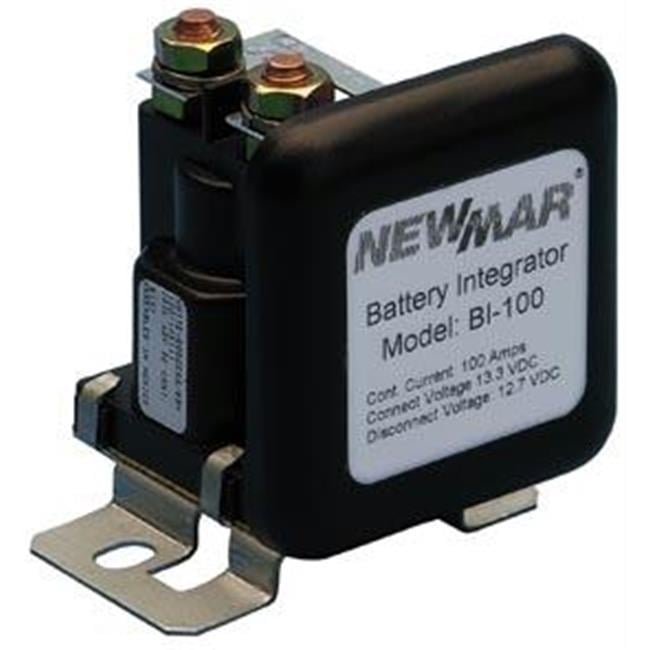
- It connects two battery banks only when a charge voltage is present so both charge together, then disconnects them at rest so one bank can't drain the other. It replaces remembering to flip a manual combine switch.
- Will it work on a 24V system?
- No. The Bi-100 is a 12V unit rated to 100 amps. For 24V systems you need a different model or a different approach.
- How much current can it pass?
- Up to 100 amps. Check your alternator and charge wiring; a bank that pulls more than that needs a higher-rated integrator.
- What connections does it use?
- 5/16-inch copper alloy studs for the battery cables. Plan ring terminals to match and keep the studs tight.
- Can it be mounted anywhere?
- Yes, it may be mounted in any orientation. Keep it dry and secure, as you would any marine electrical part.
- Is it the same as an ACR or VSR?
- Functionally similar: it combines banks during charging and isolates them otherwise. The Bi-100 is a Newmar-specific take on that job, rated at 100 amps for 12V two-bank systems.
- How is it different from a diode isolator?
- A diode isolator loses voltage as current passes through the diodes, which can undercharge the banks unless the charger compensates. The Bi-100 uses a low-resistance contactor, so there is no voltage drop in the charging system.
- At what voltage does it combine and separate the banks?
- It ties the banks together when the charge source reaches about 13.2 VDC or more, and breaks the tie when the alternator or charger is off or a large load pulls the voltage below the disconnect point.
- Where is the Newmar Bi-100 12V Battery Integrator cheapest?
- At Markem Catchem Electronics, for $220.14, as of our latest check.
- What do buyers say about the Newmar Bi-100 12V Battery Integrator?
- Rated 4.4 out of 5 from 10 ratings.
- Where can I buy the Newmar Bi-100 12V Battery Integrator?
- 9 stores we checked sell it, including Walmart, Markem Catchem Electronics, Autoplicity, eBay, Boat Gear USA.