Raspberry Pi 5 / 2 GB
Best price now
Prices are checked against each store and labelled with when.
Price facts
- Last seen at $91.93 at buyzero.de on Nov 27.

Prices are checked against each store and labelled with when.
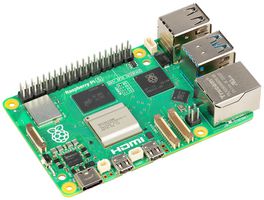
The Raspberry Pi 5 is the current generation of the single-board computer, built around a 2.4 GHz quad-core Cortex-A76 (BCM2712) with 2 GB of RAM. It roughly doubles to triples Pi 4 CPU speed, adds a much stronger GPU, a PCIe 2.0 x1 lane, dual 4K HDMI, USB 3.0 and a dedicated power button. The 2 GB model is the entry point of the line: fine for headless servers, retro gaming and light desktop work, but tight for heavy multitasking or browser-heavy use, where the 4 GB and 8 GB versions are the better fit.
In stockShips from Germany · priced in EUR (€83.90) · duties may applyReturn policy
Owners and reviewers rate the Pi 5 as a clear step up from the Pi 4 in speed and I/O. The 2 GB version draws the same praise for its price-to-capability but is often called the weakest pick for desktop use.
The Raspberry Pi 5 is a single-board computer built on the Broadcom BCM2712 system on a chip, made on a 16 nm process. Its quad-core 64-bit ARM Cortex-A76 CPU runs at 2.4 GHz, with 64 KB instruction and data caches, 512 KB of L2 cache per core and 2 MB of shared L3 cache. This version carries 2 GB of LPDDR4X-4267 RAM. A new RP1 southbridge chip adds features and raises the bandwidth of many of the interfaces.
The VideoCore V3D VII GPU runs at 1 GHz and supports OpenGL ES 3.1 and Vulkan 1.3, and a hardware decoder plays 4Kp60 HEVC video while other codecs run in software. Two microHDMI ports can drive displays at up to 4Kp60 at the same time, with HDR support. Two 4-lane MIPI connectors (DSI and CSI) run two cameras, two displays, or one camera and one display. A composite video header is present but unpopulated.
Networking comes from dual-band 2.4 GHz and 5 GHz Wi-Fi 802.11ac, Bluetooth 5.0 with BLE, and one Gigabit Ethernet port. The board has two USB 3.0 ports that can run at 5 Gbps at the same time and two USB 2.0 ports, a 40-pin GPIO header, and a single-lane PCIe Gen 2.0 interface on a flex-cable connector. Storage is a microSD slot with high-speed SDR104 support, and the board can also boot from USB 3.0 or PCIe. A power button, a real-time clock with a connector for an RTC battery, a variable-speed fan header with mounting holes, and a UART debug header running up to 921600 baud complete the board.
It checks today's price at every store, compares the alternatives and answers in about a minute.