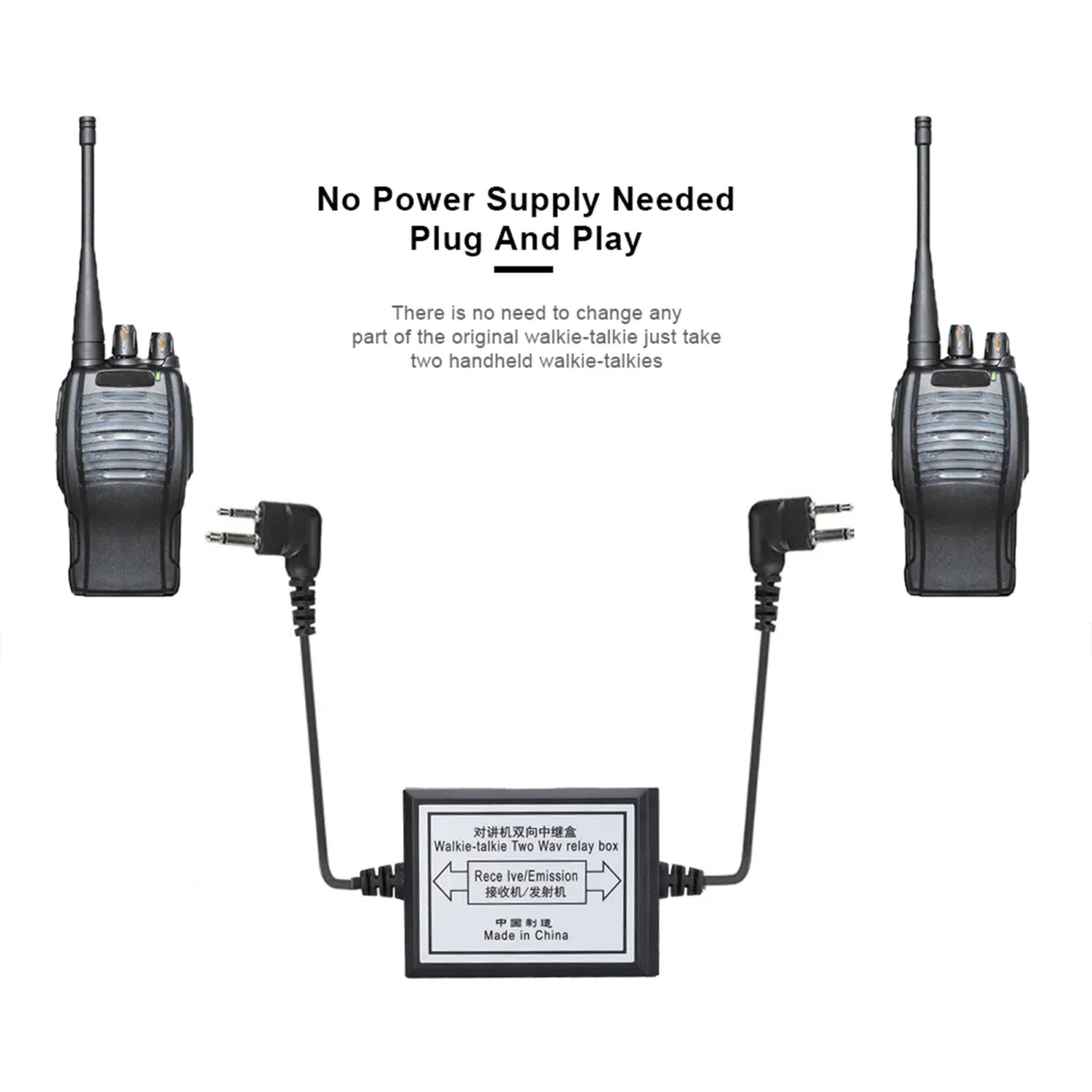
This repeater relay box connects two walkie-talkies so that one receives a signal and the other retransmits it. It has two integrated cables, each ending in a dual-pin K-type connector. It needs no power supply, and the radios do not need to be modified.
It works on audio triggering, so the volume on each radio must be set to maximum. If not, the signal may not be received. If transmission lags by more than 3 seconds, the radio's antenna is probably too close to the box and causing interference. An external walkie-talkie antenna solves this.
In one-way mode, machine A receives and machine B transmits. The two radios must be set to different frequencies, with the transmit frequency higher than the receive frequency (transmit high, receive low). A difference of about 10 MHz is typical, and a larger difference works better. Do not reverse the plugs on the one-way box, or it will not work. In two-way mode, the plugs do not distinguish between input and output. Machine A receives from machine B, and machine B receives from machine A.
- Working modes
- One-way relay (conventional relay station) and two-way forwarding
- Trigger
- Audio-triggered
- Power
- No power supply required
- Connectors
- 2 integrated cables, each with a dual-pin K-type connector
- One-way setup
- Receive and transmit radios on different frequencies, transmit high and receive low, generally 10 MHz apart
- Plug orientation
- One-way box: do not reverse the plugs. Two-way box: plugs do not distinguish input and output
- Radio volume
- Set to maximum
- Modification
- No changes to the original radios needed