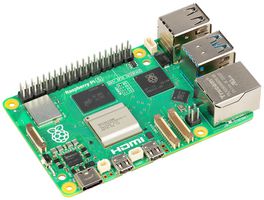
Raspberry Pi 4 Computer Model B - 8GB
Best price now
Prices are checked against each store and labelled with when.
Price facts
- Last seen at $219.00 at Longan Labs on Nov 27.

Prices are checked against each store and labelled with when.
The Raspberry Pi 4 Model B with 8GB RAM is a credit-card-sized single-board computer built around a 1.5GHz quad-core ARM Cortex-A72 (Broadcom BCM2711). It adds dual micro-HDMI outputs for 4K displays, USB 3.0 ports, Gigabit Ethernet and dual-band Wi-Fi with Bluetooth, plus the standard 40-pin GPIO header. The 8GB version is the roomiest of the Pi 4 line and suits heavier work like running a desktop, containers, a media server or a busy home lab. Against the Pi 5 it gives up CPU speed and a PCIe lane, but it runs cooler, needs no active cooler, and has the widest case and accessory support. Owners rate it as a dependable workhorse; the usual complaints are heat under sustained load and the need to buy a power supply, storage and cables separately.
In stockShips from China · duties may applyReturn policy
Owners treat the 8GB Pi 4 as a reliable small computer and server board, praising the RAM headroom, dual HDMI and USB 3.0. The recurring gripes are heat under load and the extra parts needed to get running.
The Raspberry Pi 4 Computer Model B is a single-board computer with 8GB of LPDDR4 SDRAM. It runs on a 1.5GHz 64-bit quad-core ARM Cortex-A72 CPU (Broadcom 2711). It can serve as a small computer, a controller, or the basis of a network-connected project.
Wireless LAN is built in on dual-band 2.4 GHz and 5 GHz 802.11 b/g/n/ac, along with Bluetooth 5.0 HS low-energy (BLE). The board carries two USB 2.0 ports, two USB 3.0 ports, true Gigabit Ethernet and an extended 40-pin GPIO header. Video output goes through two micro HDMI ports with 4K support, and there is a 4-pole stereo output and composite video port. A MIPI camera port (CSI) and a MIPI display port (DSI) are also on the board.
The operating system and data storage load on microSD. Power comes from a 5V/3A DC supply through the USB Type-C connector, or 5V DC through the GPIO; Power over Ethernet requires a separate compatible PoE HAT. To get started, prepare operating-system storage and a suitable 5V supply, connect the required display, peripherals and network, then boot the board and configure the system.
It checks today's price at every store, compares the alternatives and answers in about a minute.