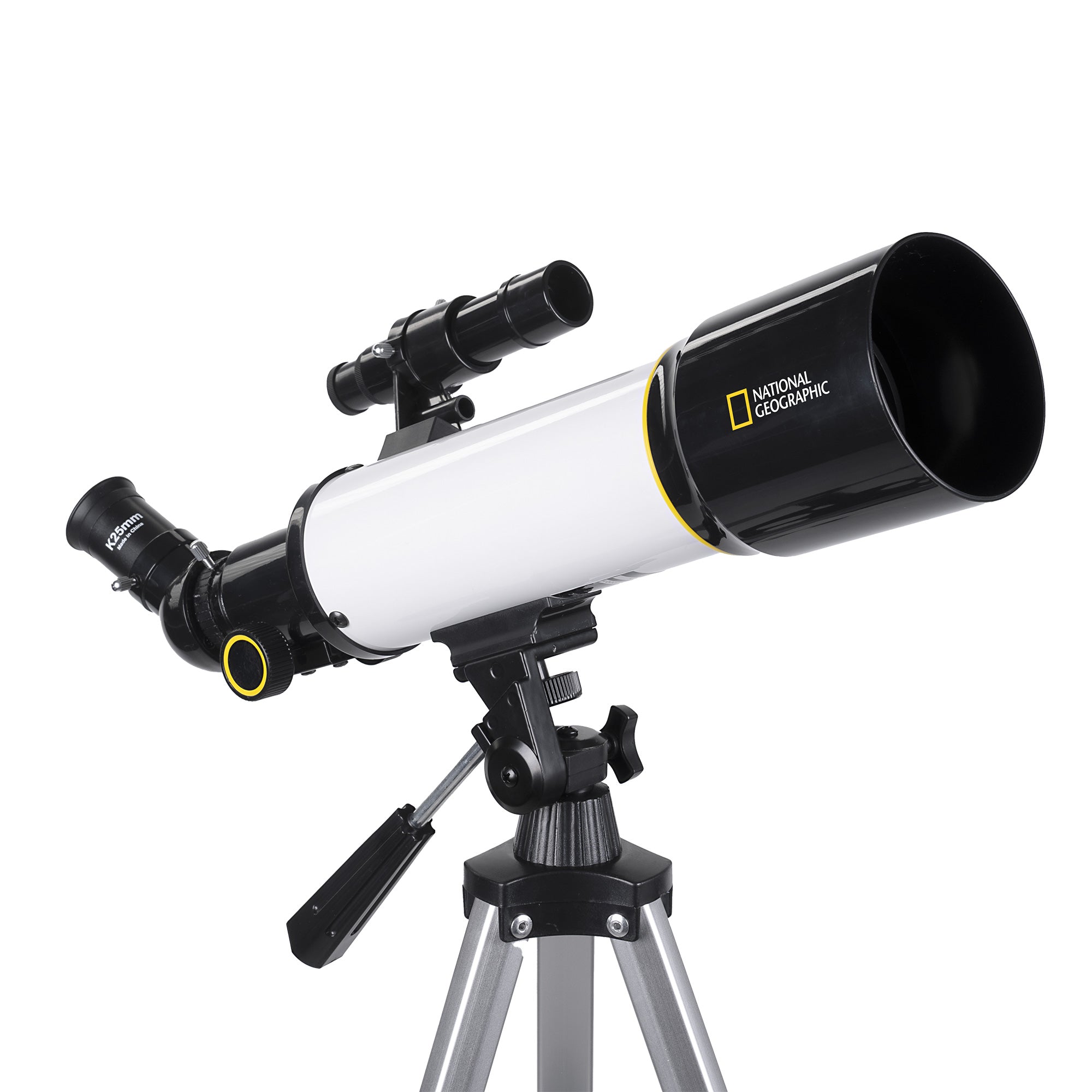
- Is the Explore FirstLight 80mm good for a beginner?
- Yes. A refractor holds collimation and needs little setup, and 80mm is enough to show lunar craters, Saturn's rings and Jupiter's moons. Expect the bundled eyepieces and mount to be the weak points, not the optics.
- Can I attach a camera to it?
- Yes, it is listed as camera adaptable. The f/8 ratio suits lunar and planetary imaging with a phone adapter or a lightweight camera, but the mount's tracking limits long exposures.
- Is 125x magnification realistic?
- That is about the maximum useful power for an 80mm scope, roughly 1.5x per millimeter of aperture. Views at 125x will be dim and affected by atmospheric seeing, so most viewing will be better around 40x to 80x.
- How does it compare with a 70mm or 90mm refractor?
- 80mm is a sensible middle step: noticeably brighter than 70mm without the size and cost of 90mm. A 90mm would show more detail on planets and clusters but is heavier and usually pricier.
- What comes in the box?
- The listing does not detail the kit. Before buying, confirm which mount, tripod, eyepieces and finder are included, since those decide whether it is usable out of the box.
- When is it cheapest?
- Only one store lists it new at $129.99 as of November 4, 2026, so there is no competing price to wait for. Telescope discounts cluster around the holidays and the start of school season.
- Where is the Explore FirstLight 80mm cheapest?
- At Astronomy Haven, for $129.99, as of our latest check.