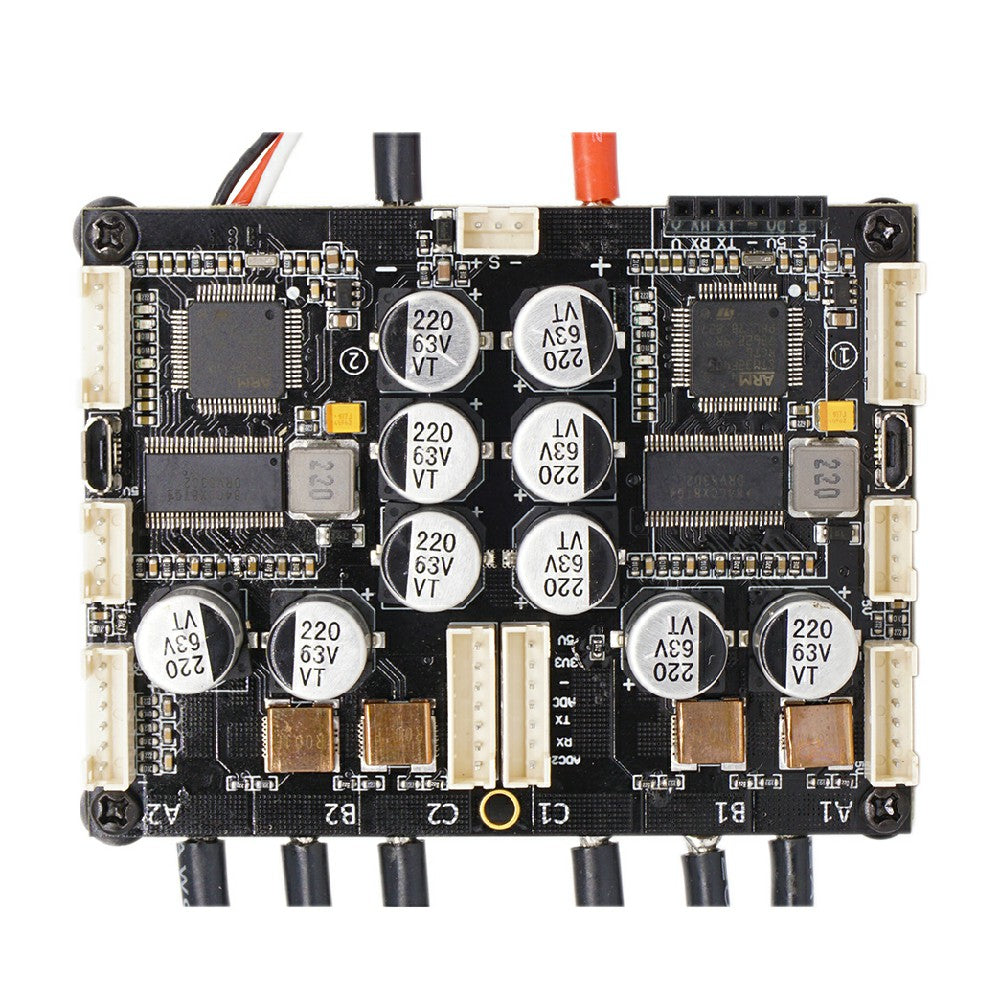
Flipsky 75200 84V High Current With Aluminum PCB Based on VESC For Fighting Robot Surfboard AGV Robot
Best price now
Prices are checked against each store and labelled with when.

Prices are checked against each store and labelled with when.
The Flipsky 75200 is a high-current motor controller built on the VESC open-source platform, aimed at builders of fighting robots, surfboards, AGVs and other high-power electric projects. It handles 14–84V (4–20S) with 200A continuous at 50V and 150A at 75V, plus 300A burst, and runs DC, BLDC and FOC modes with sensorless and sensored motor support. It ships on an aluminum PCB in a machined case, with USB, CAN, UART, SPI and IIC ports and full VESC Tool programmability. Against smaller VESC-based ESCs it trades compactness for far more current headroom, but it is a bare controller for experienced builders, not a plug-and-play part.
In stockShips from China · duties may applyReturn policy
Owners of Flipsky VESC controllers generally rate the platform for its configurability and current capability, while flagging firmware caution and the need for careful cooling and setup.
The Flipsky 75200 is a high-current electronic speed controller built on the VESC platform for fighting robots, surfboards and AGV robots. It runs on 14 to 84V, safe for 4 to 20S batteries, and delivers 200A continuous at 50V or 150A at 75V, with a 300A burst. Those current figures depend on the mounting, the ambient temperature and the air or water circulation around the device.
The board uses an aluminum PCB with good heat dissipation to extend its life span, and the 32F405 CPU runs at 168MHz. The unit measures 130 x 67.7 x 40.1mm including the aluminum case, and the motor and power wires are 8 AWG.
It runs in DC, BLDC and FOC (sinusoidal) modes and is programmable through VESC_TOOL. Communication ports are USB, CAN, UART, SPI and IIC, with two COMM ports for a UART Bluetooth module, a screen display or a remote controller. Inputs can come from PPM, ADC, NRF or UART, and the controller works with ABI, HALL, AS5047 and AS5048A sensors as well as sensorless motors. Connecting an IMU module through the IIC interface adds the function of balancing a car.
It checks today's price at every store, compares the alternatives and answers in about a minute.